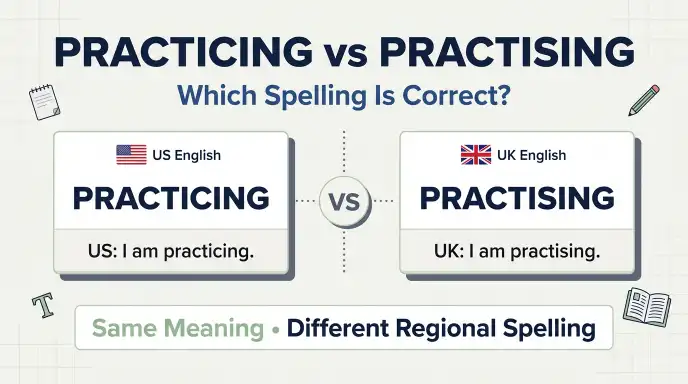
Practicing” is the standard American English spelling, while “practising” is the standard British English spelling, and both are correct depending on your audience.
Many writers get confused between practicing or practising, and even small spelling mistakes can make your writing look careless. The good news is that the difference is simple once you know the rule.
In American English, “practice” is used as both a noun and a verb, so the verb forms are “practice,” “practiced,” and “practicing.” This is the spelling used in the US, Canada (mostly), and in most American publications.
In British English, “practice” is the noun and “practise” is the verb, so the verb forms are “practise,” “practised,” and “practising.” This spelling is used in the UK, Australia, New Zealand, and India.
In this guide, we explain practicing or practising with clear examples, simple memory tricks, and common mistakes to avoid. By the end, you will know exactly which spelling to use for your readers.
Definition of Practicing or Practising:
Practicing (American English) is the present participle of the verb “practice.” It means doing an activity repeatedly to improve a skill, or working in a professional field such as medicine or law.Practising (British English) is the present participle of the verb “practise.” It has the same meaning, but it follows British spelling rules, where “practise” is the verb and “practice” is the noun.
Practicing or Practising :Quick Answer:
Which spelling is correct?
Both practicing and practising are correct. The difference depends on the type of English you use.
- Practicing: The standard spelling in American English.
- Practising: The standard spelling of the verb in British English and many other varieties, including Australian and Canadian English.
Both words mean taking part in an activity regularly to improve a skill or prepare for something.
Examples:
- American English: I am practicing my English every day.
- British English: I am practising my English every day.
Both sentences are correct. They express the same idea.
Is there a difference in meaning?
No. There is no difference in meaning between the two spellings. The difference is regional, not grammatical.
However, it is useful to remember that the noun is spelled practice in both American and British English.
For example:
- Verb: She is practicing the piano. (American English)
- Verb: She is practising the piano. (British English)
- Noun: She needs more practice. (Both varieties)
The Origin of Practicing or Practising:
Where do these words come from?
The word practice comes from older forms of French and Latin linked to doing, carrying out, or performing an activity. Over time, it became part of English and developed into a word used for repeated training, professional work, and regular action.
The verb practise developed with the same basic meaning. English spelling rules gradually differed between regions, especially as American English developed its own conventions.
In the 18th and 19th centuries, American spelling reforms helped make some words shorter or more consistent. These changes contributed to differences between American and British English.
The spelling distinction between practice and practise became an important rule in British English:
- Practice is the noun.
- Practise is the verb.
American English uses practice for both the noun and the verb.
Why do the spellings differ?
The main reason is that British and American English follow different spelling conventions.
British English often keeps the letter s in certain verbs, while American English commonly uses c in the same words. This is also seen in pairs such as advice and advise, although those words have different grammatical roles in both varieties.
The key point is that neither spelling is a mistake when used according to its regional standard.
British English vs American English Spelling
What is the main spelling rule?
The easiest way to remember the difference is to focus on the role of the word.
In American English, both the noun and verb use practice. In British English, the noun uses practice, while the verb uses practise.
| Word form | American English | British English |
| Noun | Practice | Practice |
| Verb | Practice | Practise |
| Present participle | Practicing | Practising |
| Past tense | Practiced | Practised |
| Third-person verb | Practices | Practises |
How does the rule work in sentences?
In American English, you can write:
- I practice the guitar every evening.
- He is practicing for the match.
- They practiced their lines yesterday.
In British English, you would write:
- I practise the guitar every evening.
- He is practising for the match.
- They practised their lines yesterday.
Notice that the spelling changes throughout the verb forms. If you choose British English, use practise, practising, and practised. If you choose American English, use practice, practicing, and practiced.
Does the same rule apply to other words?
Yes, a similar pattern appears in several English words.
| Meaning | American English | British English |
| Giving guidance (noun) | Advice | Advice |
| Giving guidance (verb) | Advise | Advise |
| Giving permission (verb) | License | License |
| Official permission (noun) | License | Licence |
| Training an activity (verb) | Practice | Practise |
The advice/advise pair is spelled the same way in both varieties, so it is not an example of the regional c/s difference. The license/licence pair, however, follows a similar noun-and-verb distinction in British English.
Which Spelling Should You Use?
For American readers
Use practicing when writing for an American audience.
This applies to school assignments, business emails, articles, social media posts, and other types of writing. American English uses practice as both a noun and a verb.
Examples:
- I am practicing for my driving test.
- The team is practicing before the final.
- She practiced speaking English yesterday.
For British and Commonwealth readers
Use practising when writing for a British audience. The same verb spelling is widely used in Australian and other Commonwealth English styles.
Examples:
- I am practising for my driving test.
- The team is practising before the final.
- She practised speaking English yesterday.
Canadian English often uses British-style spelling in some contexts, but usage varies. Follow the style guide used by your school, employer, publisher, or organization.
For international websites and global readers
If your website serves readers around the world, choose one spelling system and use it consistently.
For example, if your website follows American English, use practicing throughout your articles. If it follows British English, use practising.
Do not switch between the two forms without a reason. Consistent spelling makes your content easier to read and helps maintain a professional style.
Common Mistakes with Practicing or Practising:
Mistake 1: Thinking one spelling is always wrong
Some writers believe practising is incorrect because they learned American English. Others think practicing is wrong because they follow British English.
Correction: Both are correct within their respective spelling systems.
Mistake 2: Using “practise” as a British noun
In British English, practise is a verb, not the standard noun spelling.
Incorrect: I need more practise before the exam.
Correct: I need more practice before the exam.
Mistake 3: Mixing American and British spellings
A writer might use practising in one paragraph and practiced in another, even though the article follows one spelling system.
Correction: Choose one variety and apply its rules throughout the text.
Mistake 4: Confusing practice with a performance
The word practice can refer to training, a repeated activity, or professional work. It does not always mean a formal performance.
For example, a medical practice refers to a professional service or business, while practising medicine describes the act of working as a medical professional.
Mistake 5: Assuming the spelling changes the meaning
The words practicing and practising have the same meaning. One is not more formal or more correct than the other in its own regional standard.
Practicing or Practising in Everyday Examples:
In emails
American English:
“Hi Sarah, I am practicing my presentation this afternoon. Could we review it tomorrow?”
British English:
“Hi Sarah, I am practising my presentation this afternoon. Could we review it tomorrow?”
Both messages are clear and professional.
In schoolwork
American English:
“Students are practicing their spelling words before the test.”
British English:
“Students are practising their spelling words before the test.”
Use the version expected by your teacher or school.
In news and formal writing
American English:
“The players are practicing ahead of the championship.”
British English:
“The players are practising ahead of the championship.”
News organizations generally follow a house style. Their choice depends on the publication’s regional standards.
On social media
American English:
“Practicing a little every day makes a big difference.”
British English:
“Practising a little every day makes a big difference.”
Social media is less formal, but the same regional spelling rules apply.
In professional writing
American English:
“The employee is practicing new customer service techniques.”
British English:
“The employee is practising new customer service techniques.”
For formal documents, check the preferred style of your workplace or client.
Practicing or Practising : Google Trends and Usage Data:
Which spelling is more popular?
The popularity of practicing and practising depends largely on the country and the spelling conventions people learn.
In the United States, practicing is the standard verb form and is therefore generally the natural choice in American writing and searches.
In the United Kingdom, practising is the standard verb form. It is also widely used in countries that follow British spelling conventions, including Australia.
Search popularity can change over time because people search for spelling help, schoolwork, grammar rules, and writing advice. However, search volume alone does not determine which spelling is correct.
A reliable comparison would require checking Google Trends for both search terms, using the same time range and comparable country settings. Without current data, it would be misleading to claim exact search numbers or a precise popularity ranking.
What affects search interest?
Several factors can influence searches for these words:
- Country: Users often search for the spelling used in their local variety of English.
- Education: Students may check the correct spelling for essays and exams.
- Work: Professionals may want consistent spelling in emails and reports.
- Online writing: Bloggers and editors may check which spelling suits their audience.
- Grammar learning: English learners may want to understand why both forms exist.
The best approach is to choose the spelling that matches your audience rather than choosing a form simply because it appears more often online.
Comparison Table:
A quick side-by-side guide
| Feature | Practicing | Practising |
| Main region | American English | British English |
| Part of speech | Verb form | Verb form |
| Meaning | Repeating an activity to improve | Repeating an activity to improve |
| Present tense example | I am practicing. | I am practising. |
| Past tense | Practiced | Practised |
| Noun spelling | Practice | Practice |
| Correct in its own standard? | Yes | Yes |
This table shows the central rule: the meaning does not change, but the spelling follows the variety of English you use.
FAQs:
Q1: Is it practicing or practising lawyer?
Both are correct, but the spelling depends on your region. Use “practicing lawyer” in American English and “practising lawyer” in British English. A practicing (or practising) lawyer is someone who is licensed and actively working in law, as opposed to a retired lawyer or one who works in a different field. Use “practising lawyer” for readers in the UK, Australia, New Zealand, and India, and “practicing lawyer” for readers in the US.
Q2: What does “practising” mean?
“Practising” means repeatedly doing an activity to improve a skill, or actively working in a profession. It is the British English spelling of the present participle of the verb “practise.” For example, “She is practising the violin” means she is playing it repeatedly to get better, and “He is a practising doctor” means he is currently working as a doctor.
Q3: What does “practise” mean?
“Practise” is the British English verb that means to do something repeatedly to improve your skill, or to work in a profession. In the UK, “practise” is the verb and “practice” is the noun. For example, “I practise yoga every morning” uses the verb, while “yoga practice improves flexibility” uses the noun. In American English, “practice” is used for both the noun and the verb.
Q4: What is meant by practicing?
“Practicing” means doing something again and again to get better at it, or working in a particular profession. It is the American English spelling of the present participle of “practice.” For example, “He is practicing his speech” means he is rehearsing it, and “a practicing attorney” means a lawyer who is currently working in the field. It can also describe someone who actively follows a religion or custom, such as “a practicing Muslim.”
Q5: Is it practicing or practising?
Both are correct: “practicing” is American spelling and “practising” is British spelling. Choose the one that matches your audience and stay consistent throughout your writing. If your readers are in the US, use “practicing.” If they are in the UK, Australia, New Zealand, or India, use “practising.”
Q6: What is called practicing?
Practicing is the act of repeating an activity regularly to build skill, improve performance, or maintain expertise. It is also called rehearsing, training, drilling, or honing a skill. In a professional context, practicing means actively working in a field, such as practicing medicine, law, or dentistry.
Conclusion:
Choosing between practicing or practising is easy once you know the difference between American and British English. Both spellings are correct, and both describe the same action: repeating an activity to improve a skill or become better prepared.
The main rule is simple. American English uses practicing for the verb, while British English uses practising. The same pattern applies to related forms: Americans write practiced, while British writers usually write practised.
Remember that the noun is practice in both varieties. For example, you can say, “I need more practice,” if you are writing for American or British readers.
If you write articles, emails, school assignments, or website content, focus on consistency. Pick the spelling system that fits your audience and follow it throughout your writing. If you are writing for a school, company, or publication, follow its style guide.
You do not need to worry about one form being better than the other. Both are accepted in the right context. Once you learn the regional rule, you can use practicing or practising with confidence.
Find Out More!

I’m James Mitchell, a language and content writer focused on grammar, spelling, word usage, and everyday English. I enjoy making confusing words and common language questions simple and easy to understand.