Presence refers to the state of being fully engaged, visible, or established in a particular moment, place, or environment.
In today’s fast-paced world, having a strong presence:whether personal, digital, or professional:has become more important than ever. It shapes how others perceive you, connect with you, and remember you.
Many people struggle to build genuine presence because they focus on appearance rather than authenticity and consistency. True presence comes from confidence, awareness, and meaningful engagement with your surroundings.
In this article, we’ll explore what presence truly means, why it matters in modern life, and practical ways you can strengthen your own presence:starting today.
Defination:
Presence is the state of being physically or mentally engaged and noticeable in a specific place, moment, or situation. It reflects how fully a person, brand, or entity exists, participates, or is perceived within a given environment.
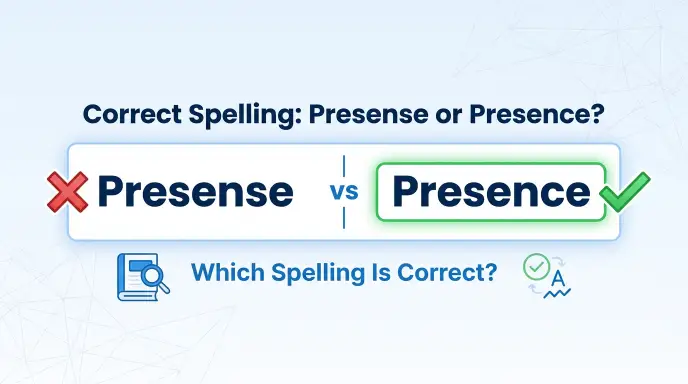
Presense or Presence : Quick Answer
Presence is the correct spelling.
Presense is incorrect and should not be used in standard English.
| Spelling | Status | Example |
| presence | ✅ Correct | Her presence made everyone feel calm. |
| presense | ❌ Incorrect | Her presense made everyone feel calm. |
Presence is a noun. It can mean the state of being somewhere, attendance, existence, or the noticeable effect or confidence a person has. Dictionaries also use it in phrases such as online presence and stage presence.
Correct examples
- Your presence is required at the meeting.
- Her presence made the room feel warmer.
- The company has a strong online presence.
- The actor has excellent stage presence.
Incorrect example
- ❌ Your presense is required at the meeting.
The correct version is:
- ✅ Your presence is required at the meeting.
A useful memory trick is to connect presence with present. If someone is present, their presence is there.
The Origin of Presense or Presence
The correct word presence has a long history. It entered Middle English through Old French presence, which came from Latin praesentia, meaning “a being present.” The Latin root is related to praesens, meaning present or being at hand.
The word has been used in English since the 14th century. Over time, it developed several meanings.
At first, presence mainly referred to the fact of being in a particular place. Later, it also came to describe someone’s appearance, bearing, influence, or impressive manner. By the early modern period, meanings connected with personal presence and spiritual presence had also developed.
This history helps explain why presence uses the -ence ending.
Why does “presense” happen?
The incorrect form presense is mainly a spelling mistake. One reason is pronunciation. Presence is pronounced roughly like PREZ-uhns, so the final sound can make writers think of words such as sense.
English also has words such as:
- sense
- defense
- offense
- pretense
This can make the spelling pattern confusing.
However, presence belongs to the group that keeps -ence in both British and American English.
So:
presence ✅
presense ❌
British English vs American English Spelling
Some English words really do have different British and American spellings. For example:
| British English | American English |
| colour | color |
| centre | center |
| behaviour | behavior |
| defence | defense |
| licence | license |
These differences can cause people to wonder if presense might be an American or British spelling.
It is not.
Both British English and American English use:
presence ✅
presense ❌
Collins gives the same spelling for British and American English, although pronunciation can vary slightly between the two varieties.
Comparison table
| Feature | British English | American English |
| Correct spelling | presence | presence |
| Incorrect spelling | presense | presense |
| Meaning | Being present or existence | Being present or existence |
| “Online presence” | Correct | Correct |
| “Stage presence” | Correct | Correct |
| Regional spelling change | None | None |
So you do not need to choose based on your audience. Whether you are writing for London, New York, Toronto, Sydney, or an international audience, presence is the safe and correct spelling.
Which Spelling Should You Use?
The answer is easy: always use presence.
For a US audience
Use:
presence
Example:
The company wants to improve its online presence.
For a UK or Commonwealth audience
Use:
presence
Example:
Your presence at the event would be greatly appreciated.
For global audiences
Use:
presence.
This is especially important for websites, business communication, academic work, resumes, and professional emails. There is no accepted regional version called presense.
Do not treat presense as a British spelling. It is simply an incorrect spelling.
Common Mistakes with Presense or Presence
1. Writing “presense”
This is the most common mistake.
❌ The teacher noticed his presense.
✅ The teacher noticed his presence.
2. Confusing it with “sense”
The ending can sound similar to sense, but the spelling is different.
❌ presense
✅ presence
3. Assuming British English uses “presense”
It does not.
British English uses presence, just like American English.
4. Confusing “presence” with “present”
These words are related but have different jobs.
Present can be an adjective:
She is present at the meeting.
Presence is a noun:
Her presence was helpful.
A simple rule is:
present = being there
presence = the state or fact of being there
5. Adding an extra “c”
Another possible spelling mistake is prescence.
❌ prescence
❌ presense
✅ presence
The correct spelling has one c and ends in -ence.
Presense or Presence in Everyday Examples
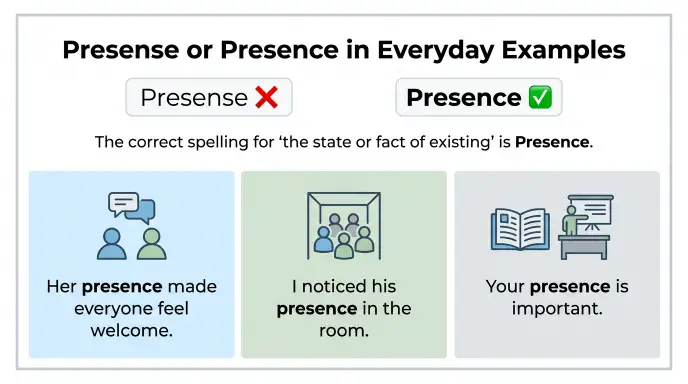
Knowing the correct spelling is useful because presence appears in many types of writing.
In Emails
Professional emails often use presence when talking about meetings or events.
We would appreciate your presence at tomorrow’s meeting.
Please confirm your presence before Friday.
Thank you for your presence and support.
Using presense in a professional email would be a spelling error.
In News Writing
News reports often use presence to describe people, groups, or objects in a location.
Police presence increased near the stadium.
The presence of emergency workers helped control the situation.
Officials confirmed the presence of several vehicles at the site.
On Social Media
The word is also common in digital communication.
She has a strong social media presence.
Building an online presence takes time.
His presence always makes the group chat more fun.
In Formal Writing
Academic and professional writing may use presence to describe existence or influence.
Researchers examined the presence of bacteria in the samples.
The study found a strong presence of digital technology in classrooms.
Her professional presence helped build trust with clients.
In Everyday Conversation
You may also hear:
I missed your presence at dinner.
I could feel someone’s presence behind me.
Your presence means a lot to me.
Presense or Presence : Google Trends & Usage Data
People often search “presense or presence” because the incorrect spelling looks believable and sounds similar to the correct one.
However, it is important to understand how Google Trends works. Google Trends measures relative search interest, not the total number of searches. A Trends graph can therefore show which term receives more interest over a selected time and location, but it should not be treated as an exact search-volume count.
For this spelling question, the important usage pattern is clear: presence is the established English word, while presense is treated as a misspelling. Modern dictionaries list presence and do not recognize presense as a standard alternative.
Search interest can come from many English-speaking and English-learning markets, including the United States, United Kingdom, Canada, Australia, and other countries where English is widely used. The search intent is usually practical: people want to check a spelling before using it in an email, assignment, article, post, or professional document.
Context also matters
The correct word appears across many contexts:
- Business: online presence
- Education: presence in class
- News: police presence
- Entertainment: stage presence
- Science: presence of chemicals
- Social media: digital presence
- Everyday English: your presence
This broad usage makes presence a useful and common English noun.
Presense vs Presence: Side-by-Side Comparison
| Variation | Correct? | Meaning | Example |
| presence | ✅ Yes | Being present or existing | His presence helped. |
| presense | ❌ No | No standard meaning | Incorrect spelling |
| prescence | ❌ No | No standard meaning | Incorrect spelling |
| present | ✅ Yes | Being there; also a gift/current | She is present. |
| presences | ✅ Yes | Plural of presence | Several presences were noticed. |
The key point is that presence is the only correct spelling when you mean the state or fact of being present.
Easy Trick to Remember “Presence”
If you often make this mistake, use this simple memory rule:
Present → Presence
Think:
If someone is present, they have a presence.
Also remember:
ENCE = correct
ENSE = incorrect
So write:
P-R-E-S-E-N-C-E
Not:
P-R-E-S-E-N-S-E
Another useful phrase is:
Your presence means you are present.
This connects the noun with the related word and makes the spelling easier to remember.
FAQs :
Q1. Which is correct, “presence” or “presense”?
The correct spelling is “presence.” The word “presense” is a common misspelling and does not exist in the English dictionary. Many people type “presense” by mistake because it sounds similar when spoken, but only “presence” is the accurate and accepted form.
Q2. What does “presence” mean?
Presence means the state of being physically or mentally engaged, visible, or noticeable in a particular place, moment, or situation. It can refer to a person’s physical existence somewhere, their influence in a room, or even a brand’s visibility online.
Q3. Is the word “presence” correct?
Yes, “presence” is the grammatically correct and standard English word. It is widely used in everyday language, business, writing, and digital marketing to describe visibility, existence, or engagement in a specific context.
Q4. What is the correct spelling of “presence”?
The correct spelling is P-R-E-S-E-N-C-E. Remember: it ends with “-ence,” not “-ense.” A helpful trick to avoid mistakes is associating it with the word “present,” since “presence” is simply “present” + “-ce.”
Conclusion
The confusion between presense or presence has a very simple answer: presence is correct, and presense is incorrect. There is no British-versus-American spelling difference here. Writers in both varieties of English should use presence.
The word has a long history. It entered English through Old French from Latin praesentia, meaning a state of being present. Over time, it gained several meanings, including being in a place, attendance, existence, personal influence, and impressive bearing.
The spelling mistake happens mainly because presence sounds similar to words such as sense and because English contains both -ence and -ense patterns. But pronunciation should not change the spelling.
When writing emails, schoolwork, news articles, social media posts, business content, or SEO articles, always choose presence. A simple way to remember it is: present → presence.
If you remember only one rule, make it this:
Presence is correct. Presense is not.
Related Topics!

I’m James Mitchell, a language and content writer focused on grammar, spelling, word usage, and everyday English. I enjoy making confusing words and common language questions simple and easy to understand.





2 thoughts on “Presense or Presence: Which Spelling Is Correct?”