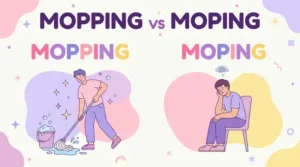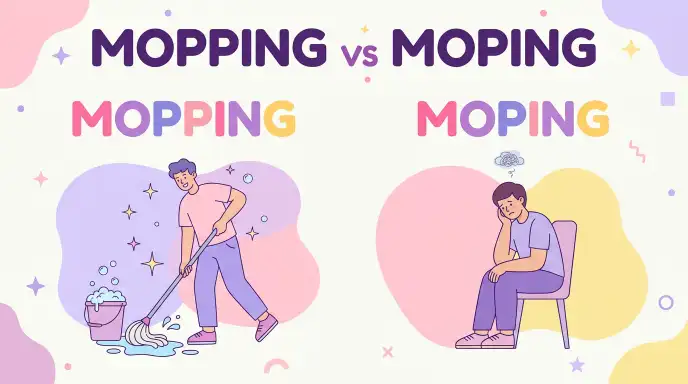
“Mopping” is the correct spelling for cleaning a floor with a mop, while “moping” (with one “p”) means feeling gloomy or sulking.
Mopping and moping look almost identical, but they have completely different meanings. A single extra letter is enough to turn a cleaning chore into a bad mood.
The difference comes down to a basic English spelling rule. When a short verb like “mop” takes an “-ing” ending, the final consonant is doubled to keep the vowel sound short, which gives us “mopping.”
“Moping,” on the other hand, comes from the verb “mope,” which ends in a silent “e.” The “e” is dropped before adding “-ing,” so the “o” stays long, as in “rope.” As a result, the two words are pronounced differently as well.
In this article, we’ll explain the meaning of each word, show how to use them correctly in sentences, and share simple tricks to avoid mixing them up. You’ll also see common mistakes so you can write with confidence.
Mopping or Moping : Quick Answer
What Does Mopping Mean?
Mopping means cleaning a floor or another surface with a mop. It is the -ing form of the verb mop. People often use a mop with water or a cleaning solution to remove dirt, dust, and spills.
Examples:
- I am mopping the kitchen floor.
- She was mopping the hall when I arrived.
- He spends every Saturday mopping the shop.
In each sentence, mopping refers to cleaning.
What Does Moping Mean?
Moping means feeling sad, unhappy, or low in mood, often while doing very little or staying away from others. It is the -ing form of the verb mope.
Examples:
- Stop moping and come outside.
- He was moping after losing the game.
- She spent the afternoon moping in her room.
In these sentences, moping describes a person’s mood or behavior.
The Main Difference
The easiest way to remember these words is to connect each one with its meaning.
| Word | Meaning | Easy Example |
| Mopping | Cleaning with a mop | I am mopping the floor. |
| Moping | Feeling sad or gloomy | He is moping after the news. |
Quick tip: If the sentence is about cleaning, use mopping. If it is about sadness or low spirits, use moping.
The Origin of Mopping or Moping:
Where Does the Word Mopping Come From?
The word mopping comes from the verb mop. A mop is a tool used to clean floors and other surfaces. The verb mop means to clean or wipe something with a mop.
The word mop has been used in English for centuries. Its exact early origin is not fully certain, but it became linked with cleaning tools and the act of wiping surfaces.
When you add -ing to mop, you get mopping. The final consonant is doubled because mop has a short vowel sound and ends in a single consonant.
Here are some examples:
- Mop → Mopping
- Shop → Shopping
- Stop → Stopping
This spelling pattern helps keep the short vowel sound in the word.
Where Does the Word Moping Come From?
The word moping comes from the verb mope. To mope means to feel sad, gloomy, or unhappy, often in a quiet or withdrawn way.
The word mope has been used in English since around the late Middle Ages. Its exact origin is uncertain. Over time, it came to describe a person who looks sad or spends time feeling low instead of taking part in normal activities.
When you add -ing to mope, you get moping. You do not double the final consonant because the word ends in a silent e. That e is dropped before adding -ing.
Examples:
- Hope → Hoping
- Smile → Smiling
- Mope → Moping
Why Are the Spellings Different?
The main reason is the spelling of each base verb.
Mop ends in a consonant after a short vowel, so the final consonant is doubled before adding -ing. Mope ends in a silent e, so the e is removed before adding -ing.
This is a common English spelling rule. It explains why mopping has a double p, while moping has only one p.
British English vs American English Spelling:
Are Mopping and Moping Different in the UK and the US?
No. Both mopping and moping are correct spellings in British and American English. Their meanings also stay the same in both forms of English.
Some English words change spelling between the UK and the US. For example, British English often uses colour, while American English uses color. However, the spelling difference between mopping and moping is not regional.
The correct word depends on its meaning, not on the country where you live.
Comparison Table: British vs American Usage
| Point | British English | American English |
| Cleaning a floor | Mopping | Mopping |
| Feeling sad or gloomy | Moping | Moping |
| Double p in mopping | Yes | Yes |
| Single p in moping | Yes | Yes |
| Meaning changes by region | No | No |
Examples in Both Forms of English
British English:
- The cleaner is mopping the school hall.
- He is moping because his friends left early.
American English:
- Mom is mopping the kitchen floor.
- She has been moping since the team lost.
All four examples use the same spellings. You do not need to change either word for a British or American audience.
Which Spelling Should You Use?
Use Mopping When You Mean Cleaning
Choose mopping when someone is cleaning a floor or surface with a mop. It can describe an action that is happening now, happened in the past, or takes place regularly.
Examples:
- I am mopping the bathroom floor.
- They were mopping the school hallway.
- The staff are mopping the shop before opening.
If the action involves a mop, mopping is usually the right choice.
Use Moping When You Mean Feeling Sad
Choose moping when you want to describe sadness, low spirits, or withdrawn behavior.
Examples:
- He is moping after his argument with a friend.
- She kept moping instead of joining the group.
- The child was moping because the trip was canceled.
The word can sometimes sound critical. For example, telling someone to “stop moping” may suggest that they should try to feel better or take action. Use it with care if the person is upset about something serious.
Advice for Different Audiences
| Audience | Best Advice |
| US readers | Use the word that matches the intended meaning. |
| UK readers | Follow the same spelling and meaning rules. |
| Commonwealth readers | Both words are standard English. |
| Global readers | Add context if the sentence could be unclear. |
| Formal writing | Choose precise wording and avoid unclear sentences. |
You can use both words in the same paragraph if you need to describe two different actions.
Example: “After mopping the floor, Liam sat on the sofa, moping about his lost phone.”
Here, mopping describes cleaning, while moping describes Liam’s mood.
Common Mistakes with Mopping or Moping:
Mistake 1: Using Moping for Cleaning
Incorrect: “I am moping the kitchen floor.”
Correct: “I am mopping the kitchen floor.”
Why? The sentence describes cleaning, so mopping is the correct word.
Mistake 2: Using Mopping to Describe Sadness
Incorrect: “She is mopping because she misses her friends.”
Correct: “She is moping because she misses her friends.”
Why? The sentence describes a sad mood, not a cleaning task.
Mistake 3: Forgetting the Double P
Incorrect: “He is moping the floor.”
Correct: “He is mopping the floor.”
The verb mop doubles its final p when you add -ing. This gives you mopping.
Mistake 4: Doubling the P in Moping
Incorrect: “He was mopping around the house because he felt sad.”
Correct: “He was moping around the house because he felt sad.”
The verb mope loses its silent e before -ing. It does not need a double p.
Mistake 5: Thinking One Word Is British and the Other Is American
Incorrect idea: “Mopping is American, but moping is British.”
Correct idea: Both words are used in British and American English. They have different meanings, not different regional spellings.
A Simple Way to Avoid These Errors
Ask yourself one question: Am I talking about cleaning or a person’s mood?
- Cleaning means mopping.
- Sadness or gloomy behavior means moping.
This quick check will help you choose the right spelling in most everyday sentences.
Mopping or Moping in Everyday Examples:
In Emails and Work Messages
Both words may appear in work messages, but they communicate different ideas.
Examples:
- “The team is mopping the office floor after the spill.”
- “He has been moping since he received the bad news.”
- “Please wait until the staff finish mopping the entrance.”
In a work email, use mopping when discussing cleaning duties. Use moping only when a person’s mood is relevant to the message.
In News and Reports
News reports may use mopping when describing cleaning work or the removal of a spill. The word moping may appear in a story about someone’s behavior or emotional response.
Examples:
- “Workers were mopping the floor after the water leak.”
- “The player was seen moping after the team’s defeat.”
These are sample sentences, not quotes from real news reports.
On Social Media
People often use short, casual sentences on social media. Both words can fit, depending on the situation.
Examples:
- “Finally mopping my room before the weekend!”
- “Just moping around because my plans got canceled.”
- “Done mopping. Now I can relax.”
The first and third examples describe cleaning. The second describes a low mood.
In School and Formal Writing
For schoolwork, essays, and reports, choose the word that expresses your meaning clearly.
Examples:
- “The caretaker was mopping the corridor.”
- “The character sat alone, moping after the argument.”
- “After mopping the kitchen, Maya noticed that her brother was moping on the sofa.”
In creative writing, moping can help show a character’s mood. In a practical report, mopping may describe a cleaning task.
Mopping or Moping : Usage and Search Intent:
Why Do People Search for These Words?
People may search for “mopping or moping” because the words differ by only one letter pattern. Both end in -ing, and they look similar when read quickly. However, the base verbs mop and mope have different meanings.
A person may also hear one of these words in conversation and want to confirm its spelling. Others may be editing a message, writing a school assignment, or checking a sentence before publishing it.
Are the Words Equally Common?
The two words appear in different contexts. Mopping is used when people discuss household chores, cleaning jobs, spills, or floor care. Moping is used when people discuss sadness, disappointment, or withdrawn behavior.
Their use depends on the subject of the sentence. It would be misleading to claim that one is more popular in a particular country without checking reliable, current usage data. Neither spelling is limited to British or American English.
How to Choose the Right Word Quickly
Look at the words around it:
- If you see floor, mop, cleaner, or spill, you may need mopping.
- If you see sad, lonely, disappointed, or upset, you may need moping.
These clues are useful, but always check the full sentence. Context is the best way to identify the intended meaning.
Mopping vs Moping: Comparison Table
Meaning, Spelling, and Examples Side by Side
| Feature | Mopping | Moping |
| Base verb | Mop | Mope |
| Main meaning | Cleaning with a mop | Feeling sad or gloomy |
| Spelling rule | Double the p | Drop the silent e |
| Common context | Home, school, workplace | Personal feelings and behavior |
| Example | She is mopping the floor. | She is moping after the loss. |
| British English | Correct | Correct |
| American English | Correct | Correct |
Quick Sentence Check
| Sentence | Correct Word | Why? |
| He is ___ the kitchen. | Mopping | He is cleaning the floor. |
| She is ___ after the argument. | Moping | She feels sad. |
| They were ___ the hallway. | Mopping | They were cleaning. |
| The boy kept ___ all day. | Moping | He was acting sad or gloomy. |
Use these tables as a quick guide whenever you are unsure which word fits your sentence.
FAQs:
1. What Is the Main Difference Between Mopping and Moping?
Mopping means cleaning a surface with a mop. Moping means feeling sad or gloomy, often while being quiet or withdrawn.
Example: “I am mopping the floor” describes cleaning. “I am moping after the bad news” describes a mood.
2. Is Mopping a Real Word?
Yes. Mopping is the correct -ing form of mop. It means cleaning or wiping a surface with a mop.
Example: “She is mopping the kitchen floor.”
3. Is Moping a Real Word?
Yes. Moping is the correct -ing form of mope. It describes feeling sad, gloomy, or unhappy.
Example: “He is moping because his friends went home.”
4. Why Does Mopping Have Two Ps?
The verb mop ends in a consonant after a short vowel. When you add -ing, you double the final consonant, giving you mopping.
The same rule applies to words such as shop and stop: shopping and stopping.
5. Why Does Moping Have Only One P?
The base verb mope ends in a silent e. Before adding -ing, you drop that e. The result is moping, not mopping.
6. Are Mopping and Moping British or American Spellings?
Both words are correct in British and American English. They are not spelling variations of the same word. They have different meanings and are used in the same way across these varieties of English.
7. Can I Use Mopping and Moping in One Sentence?
Yes. You can use both words in the same sentence when you are describing cleaning and sadness.
Example: “After mopping the floor, Jack sat down, moping about his canceled plans.”
This sentence uses each word correctly.
Conclusion:
The difference between mopping and moping is simple once you know what each word means. Mopping refers to cleaning a floor or surface with a mop. Moping refers to feeling sad, gloomy, or unhappy, often while keeping to yourself. Although the words look similar, they are not interchangeable.
Remember the spelling rules, too. The verb mop becomes mopping because its final p is doubled before adding -ing. The verb mope becomes moping because its silent e is removed. These rules apply in both British and American English, so you do not need to choose a different spelling based on your audience.
When you are unsure, read the whole sentence and ask what action or feeling you want to describe. If someone is cleaning, use mopping. If someone is feeling low, use moping. This small check can prevent mistakes in emails, social media posts, schoolwork, and professional writing.
Deep dive!

I’m James Mitchell, a language and content writer focused on grammar, spelling, word usage, and everyday English. I enjoy making confusing words and common language questions simple and easy to understand.