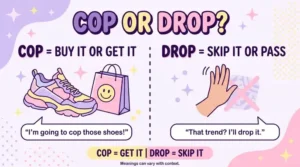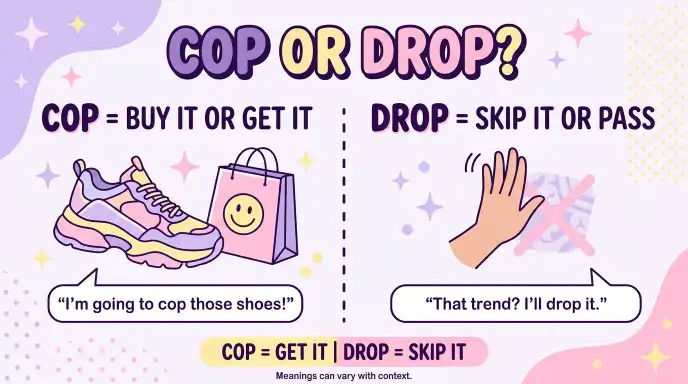
“Cop or drop” is a slang phrase that asks whether you would buy something (cop) or skip it (drop).
It started in sneaker and streetwear culture, where fans vote on new releases. “Cop” means to buy or get an item, while “drop” means to pass on it.
Today the phrase is used far beyond shoes, including clothes, gadgets, cars, and even food. Social media posts, YouTube videos, and TikTok trends often use it to ask for quick opinions.
Many people get confused because “drop” also means a new product release, which is a different meaning. The context of the sentence is what tells you which one is being used.
In this article, we explain the meaning of cop or drop, where it came from, and how to use it. By the end, you will understand this slang and use it with confidence.
Cop or Drop : Quick Answer
What Does “Cop or Drop” Mean?
“Cop or drop” is a slang expression used to decide if something is worth getting or if it should be passed over.
- Cop: Buy, get, or choose something.
- Drop: Skip, reject, or decide not to buy something.
For example, imagine that a clothing brand releases a new pair of sneakers. Someone posts a picture and asks, “Cop or drop?”
You can answer:
- “Cop! Those shoes look amazing.”
- “Drop. I don’t like the color.”
- “Easy cop. I would wear these every day.”
- “Hard drop. They cost too much.”
The phrase is often used in fashion, but it can also apply to gadgets, accessories, games, and other products.
Is “Cop or Drop” Positive or Negative?
The phrase itself is neutral. The meaning depends on the answer.
If someone says “cop,” they like the item enough to get it. If they say “drop,” they do not want it or do not think it is worth buying.
For example:
“Those new headphones are a cop for me.”
This means the speaker wants to buy or get the headphones.
“Those headphones are a drop.”
This means the speaker would pass on them.
The phrase is casual, so it works best in friendly chats and online discussions rather than formal business writing.
The Origin of “Cop or Drop”:
Where Does the Word “Cop” Come From?
The word “cop” has been used as slang for getting or obtaining something for a long time. In modern informal speech, it can mean buying an item, especially clothing, shoes, or something desirable.
For example:
- “I finally copped those sneakers.”
- “She wants to cop a new jacket.”
- “He copped a limited-edition shirt.”
In streetwear culture, “cop” became closely linked with buying sought-after products. People use it when talking about new releases, limited-edition shoes, fashion collections, and other items they want to own.
The word can have other meanings in English, too. For example, “cop” can refer to a police officer. However, in the phrase “cop or drop,” it refers to getting or buying something.
What Does “Drop” Mean in This Phrase?
The word “drop” has several meanings in English. In this expression, it means to leave something behind or decide against getting it.
For example:
- “I would drop those shoes because they are too expensive.”
- “That jacket is a drop for me.”
- “I like the design, but I would drop it because of the price.”
The word also appears in fashion and music. A brand may “drop” a new collection, which means it releases the products. This is a different use of the word.
Therefore, the meaning of “drop” depends on the context. In “cop or drop,” it usually means pass on the item.
How Did “Cop or Drop” Become Popular?
The phrase fits the quick, opinion-based style of online fashion culture. Social media users often share photos of new products and ask followers to choose between buying and skipping them.
Sneaker communities helped make this type of question familiar because new shoes can attract strong opinions. People discuss colors, designs, prices, comfort, and how rare a release may be.
Short videos and photo posts also make the phrase easy to use. A creator can show an item and ask viewers to comment “cop” or “drop.”
Today, the phrase is used more broadly than sneakers. People may ask it about outfits, watches, bags, phones, gaming accessories, and other products.
British English vs. American English Usage:
Is “Cop or Drop” Different in British and American English?
The phrase does not have a different spelling in British and American English. Both use the words “cop” and “drop.”
However, slang can vary by region. The word “cop” is widely understood in American streetwear and online fashion culture. It may also be understood by British and other English-speaking audiences, especially those familiar with sneaker culture and social media.
The meaning remains the same: get the item or pass on it.
| Feature | American English | British English |
| Phrase | Cop or drop | Cop or drop |
| Meaning of “cop” | Buy or get | Buy or get |
| Meaning of “drop” | Pass on or reject | Pass on or reject |
| Common setting | Streetwear, sneakers, social media | Streetwear, sneakers, social media |
| Formal writing | Usually avoided | Usually avoided |
Does the Phrase Have Different Spellings?
No. The standard phrase is “cop or drop.” It does not require a British spelling or an American spelling.
You may see variations in capitalization, such as “Cop or Drop?” or “cop or drop,” depending on if it appears in a heading, caption, or sentence.
Both forms can be correct in the right context.
For example:
- “Cop or drop? Let me know below.”
- “My answer is an easy cop.”
- “Would you cop these trainers or drop them?”
In British English, people may use “trainers” where Americans often use “sneakers.” The slang phrase itself does not change.
Which Spelling or Phrase Should You Use?
For American Readers
If your audience is in the United States, “cop or drop” is a natural choice for casual fashion and sneaker discussions.
Examples:
- “Cop or drop these new sneakers?”
- “Would you cop this hoodie?”
- “These shoes are a cop for me.”
The phrase works well in social media captions, product discussions, and friendly conversations.
For British and Commonwealth Readers
Readers in the United Kingdom, Australia, Canada, and other English-speaking regions may also understand “cop or drop,” particularly if they follow streetwear trends.
You can use it in casual posts and fashion discussions. If your audience may not know the slang, add a short explanation.
For example:
“Cop or drop? Would you buy these trainers or leave them?”
This makes the question clear to a wider audience.
For a Global Audience
If you are writing for people from different countries, use simple wording or explain the phrase the first time it appears.
For example:
“Cop or drop means buy it or pass on it. Which would you choose?”
This helps readers who are learning English or are unfamiliar with fashion slang.
Should You Use It in Formal Writing?
Usually, no. The phrase is informal and works best in social posts, blogs about streetwear, and casual conversations.
For a formal report, use clearer alternatives such as:
- “Would you buy this product?”
- “Should we purchase this item?”
- “Would you recommend this product?”
Choose your wording based on your audience and the purpose of the message.
Common Mistakes with “Cop or Drop”:
Mistake 1: Thinking “Cop” Only Means a Police Officer
In everyday English, “cop” can refer to a police officer. However, in the phrase “cop or drop,” it means to get or buy something.
Incorrect understanding: “Cop or drop is asking about police officers.”
Correct understanding: “Cop or drop asks if you would get an item or pass on it.”
The words around “cop” help you understand its meaning.
Mistake 2: Thinking “Drop” Always Means Release
A product release is often called a “drop.” For example, a brand may announce a new sneaker drop.
However, when someone asks “cop or drop?” they are asking if you would buy the item or skip it.
Compare these examples:
- “The brand will drop new shoes on Friday.” This means the shoes will be released.
- “Those shoes are a drop for me.” This means the speaker would not buy them.
The context changes the meaning.
Mistake 3: Using the Phrase in a Formal Email
The expression may sound too casual in a business email or formal report.
Informal: “Cop or drop this new design?”
More professional: “Would you recommend purchasing this design?”
Use slang when it suits your audience, not simply because it is popular online.
Mistake 4: Assuming Everyone Must Agree
“Cop or drop” asks for an opinion. One person may love an item while another dislikes it.
For example:
- Person A: “Easy cop. The color is perfect.”
- Person B: “Drop. I don’t like the shape.”
Both answers are valid because the phrase is based on personal taste.
Mistake 5: Confusing “Cop” With “Keep”
The words can sometimes lead to confusion, but they are not the same.
“Cop” means to get or buy something in this slang context. “Keep” means to continue having or holding something.
For example:
“I would cop those shoes” means “I would buy those shoes.”
“I would keep those shoes” means “I would continue to own them.”
“Cop or Drop” in Everyday Examples:
In Fashion and Streetwear
This is one of the most common settings for the phrase.
Examples:
- “Cop or drop this oversized hoodie?”
- “Those new sneakers are a cop!”
- “I would drop that jacket because the fit looks odd.”
- “Cop or drop these limited-edition trainers?”
The question encourages people to share their style preferences.
On Social Media
The phrase works well in short captions and comments.
Examples:
- “Cop or drop? Rate this outfit.”
- “New collection just landed. Which piece is a cop?”
- “Be honest: cop or drop?”
- “I say cop, but what do you think?”
It is popular as a type of opinion prompt because it is short and easy to answer.
In Group Chats
Friends may use the phrase when sharing products they are thinking about buying.
Examples:
- “I found these shoes online. Cop or drop?”
- “Definitely cop. They match your style.”
- “Drop for me. You can find better ones.”
- “Should I cop this jacket or save my money?”
In this setting, the phrase can make shopping conversations more fun.
In Product Reviews
Content creators may use the phrase to give a quick verdict on a product.
Examples:
- “Cop: the headphones have great features for the price.”
- “Drop: the design looks good, but the battery life is poor.”
- “My final verdict is cop if you need an affordable option.”
A useful review should explain the reasons behind the verdict rather than relying only on slang.
In Emails and Formal Writing
The phrase is usually too informal for professional communication. However, you can translate the idea into clear business language.
Informal:
“Cop or drop this product?”
Professional:
“Would you recommend buying this product?”
Informal:
“This new design is a cop.”
Professional:
“I recommend purchasing this design.”
The meaning stays similar, but the professional versions suit a wider range of readers.
“Cop or Drop” : Google Trends and Usage Data
Is “Cop or Drop” a Popular Search Term?
The phrase is associated with sneaker culture, fashion opinions, and online shopping discussions. People may search for its meaning after seeing it in a video, caption, or comment.
However, the exact search volume can change over time. It is not reliable to claim that “cop or drop” is more popular in a specific country without checking current data.
Search interest may also differ by context. Some people want a definition, while others look for outfit ratings, sneaker opinions, or product recommendations.
How Can You Check Search Interest?
You can use Google Trends to explore the phrase and related searches.
- Open Google Trends.
- Enter “cop or drop.”
- Choose a country or select worldwide data.
- Select a time range.
- Compare the phrase with related terms such as “cop meaning slang” or “sneaker slang.”
- Review related queries if Google Trends provides them.
Google Trends shows relative search interest on a normalized scale from 0 to 100. It does not provide exact search counts.
What Does This Mean for seo?
If you are writing an article about “cop or drop,” focus on the main question first: what does the phrase mean?
Then provide examples, explain its use in fashion, and show how it differs from similar expressions. This helps readers understand both the definition and the context.
Use the keyword naturally in the title, introduction, and relevant headings. Avoid repeating it in every paragraph just to increase keyword frequency.
No article can guarantee a top Google ranking. Clear explanations, accurate information, useful examples, and a good reading experience are stronger goals than keyword stuffing.
Comparison Table:
Several slang phrases express a similar idea, but they are not always interchangeable.
| Phrase | Meaning | Example |
| Cop or drop | Buy it or pass on it | “Cop or drop these shoes?” |
| Keep or toss | Keep something or get rid of it | “Keep or toss this old jacket?” |
| Buy or pass | Purchase it or skip it | “Buy or pass on these headphones?” |
| Fire or trash | Something is great or very bad | “Are these sneakers fire or trash?” |
| Hit or miss | Something is successful or unsuccessful | “Is this new design a hit or miss?” |
| Yay or nay | Yes or no; approve or reject | “Yay or nay on this outfit?” |
“Cop or drop” is especially suited to buying decisions and fashion opinions. Other phrases may fit a wider range of situations.
FAQs :
1. What does “cop or drop” mean in slang?
“Cop or drop” means deciding if to buy or get something or pass on it. It is often used for sneakers, clothes, accessories, and other products.
2. What does “cop” mean in fashion?
In fashion slang, “cop” means to buy or get an item. For example, “I want to cop those sneakers” means “I want to buy those sneakers.”
3. What does “drop” mean in “cop or drop”?
It means to skip or reject an item rather than buy it. The word can have other meanings in different contexts, including releasing a new product.
4. Is “cop or drop” only used for sneakers?
No. Although it is common in sneaker culture, people also use it for clothing, watches, bags, gadgets, and other products.
5. Is “cop or drop” positive or negative?
The phrase is neutral. “Cop” usually shows interest in getting an item, while “drop” shows that someone would pass on it.
6. Can I use “cop or drop” in formal writing?
It is best suited to informal writing, social media, and casual conversations. In professional writing, use phrases such as “buy or pass” or “would you recommend this product?”
7. What is the difference between “cop or drop” and “keep or toss”?
“Cop or drop” usually asks if someone would buy or skip an item. “Keep or toss” asks if someone should continue keeping something or get rid of it.
Conclusion:
“Cop or drop” is a popular slang expression used to ask if someone would buy or get an item or pass on it. The word “cop” means to obtain or buy something, while “drop” means to skip or reject it. Together, the words create a quick question that invites people to share their opinions.
The phrase is often used in sneaker culture, streetwear, fashion posts, and online shopping discussions. For example, someone may share a picture of new shoes and ask, “Cop or drop?” One person may love the design and say “cop,” while another may dislike the price and say “drop.”
The phrase has the same basic meaning for American, British, and other English-speaking audiences familiar with online fashion slang. However, because it is informal, it is better suited to casual conversations than formal reports or business emails.
If you are learning English, remember that context matters. “Cop” can refer to a police officer in other situations, and “drop” can mean release something. In this phrase, they describe a buying choice.
In short, use “cop or drop” when asking for a quick opinion about an item. For formal writing, choose clearer alternatives such as “buy or pass.” This keeps your message easy to understand and appropriate for your audience.
Find out more!

I’m James Mitchell, a language and content writer focused on grammar, spelling, word usage, and everyday English. I enjoy making confusing words and common language questions simple and easy to understand.