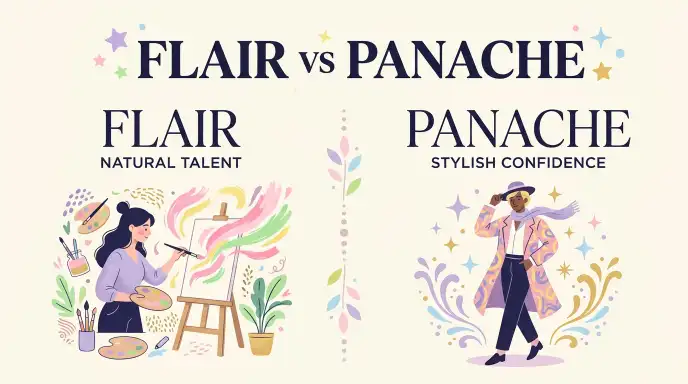
“Flair” and “panache” both describe stylish confidence, but flair means a natural talent, while panache means a bold, showy style.
You can say someone has “a flair for cooking” when they are naturally good at it. You can say they do something “with panache” when they do it with confidence and style.
The two words overlap, which is why writers often swap them. They are not always interchangeable, because flair can describe a skill and panache describes the manner in which something is done.
Panache comes from the French word for a feather plume, which is why it feels dramatic and elegant. Flair comes from an old word for smell, which later came to mean a gift for sensing what works.
In this article, we explain the difference between flair and panache with simple examples. By the end, you will know exactly which word fits your sentence.
Flair or Panache : Quick Answer
What is the difference between flair and panache?
Flair means a natural talent, special skill, or stylish way of doing something. Panache means a confident, bold, and stylish manner that often attracts attention.
For example:
- She has a flair for writing. (She has a natural talent for writing.)
- He presented his ideas with panache. (He presented them with style and confidence.)
Both words can describe style, but they focus on different things.
When should you use flair?
Use flair when you want to highlight talent, creativity, or a special ability.
Examples:
- She has a flair for fashion.
- The artist painted the room with flair.
- He has a flair for solving problems.
When should you use panache?
Use panache when you want to highlight bold style, confidence, or a striking way of acting.
Examples:
- The dancer performed with panache.
- She entered the room with panache.
- The team celebrated its victory with panache.
Quick comparison table
| Flair | Panache |
| Often means natural talent | Often means bold style |
| Highlights skill or creativity | Highlights confidence and showmanship |
| She has a flair for design. | She presented the design with panache. |
| Can describe an ability | Often describes a manner or performance |
Remember this simple rule: flair is often about talent, while panache is often about style and confidence.
The Origin of Flair or Panache:
Where does the word flair come from?
The word flair comes from French. It entered English with the sense of a keen sense or instinct. Today, it often refers to a natural ability to recognize, create, or do something well.
For example, someone with a flair for music may have a strong sense of rhythm, melody, or creative expression.
The word can also describe a special style that makes something stand out.
Examples:
- The designer has a flair for color.
- She decorated the cake with flair.
- He writes stories with flair.
In these sentences, the word suggests skill, creativity, or a distinctive touch.
Where does the word panache come from?
The word panache also comes from French. Its earlier meaning referred to a plume or cluster of feathers, often worn on a helmet or hat.
Such feathers could make a person look striking and impressive. Over time, the word developed a wider meaning: a bold, confident, and stylish way of behaving.
For example:
“The actor accepted the award with panache.”
This means the actor accepted the award with confidence and style.
The word is often used when a person’s actions are impressive, lively, or full of character.
Why do the words have different meanings?
Both words came into English from French, but their meanings developed in different ways.
Flair became closely linked to instinct, talent, and special ability. Panache became linked to visible style, boldness, and confident behavior.
This is why the words can sometimes describe the same person but highlight different qualities.
Consider this example:
“Maria has a flair for public speaking and delivers every speech with panache.”
Here, flair describes her ability, while panache describes the stylish way she presents her speech.
British English vs American English Spelling:
Are flair and panache spelled differently in British and American English?
No. Both words have the same standard spelling in British English and American English.
Unlike words such as colour and color, there is no standard regional spelling difference between flair and panache.
Examples:
- British English: She has a flair for design.
- American English: She has a flair for design.
- British English: He performed with panache.
- American English: He performed with panache.
All these sentences are correct.
Comparison table: British English vs American English
| Feature | British English | American English |
| Spelling of flair | Flair | Flair |
| Spelling of panache | Panache | Panache |
| Meaning of flair | Talent or special style | Talent or special style |
| Meaning of panache | Bold style and confidence | Bold style and confidence |
| Common phrase | A flair for writing | A flair for writing |
| Common phrase | With panache | With panache |
Does pronunciation change the meaning?
The pronunciation can vary slightly between speakers, but the core meanings remain the same.
Flair is usually pronounced like “flair,” rhyming with care. Panache is often pronounced “puh-NASH,” with the stress on the second syllable.
Knowing how to say the words can help you recognize them in conversation. However, the best way to choose between them is to understand what you want to describe.
Which Word Should You Use?
If your readers are in the United States
Use flair when you mean talent, creativity, or a special ability. Choose panache when you mean bold style or confident presentation.
Examples:
- She has a flair for business.
- He handled the interview with panache.
Both words are common in standard English, although panache may sound more expressive or literary in some contexts.
If your readers are in the United Kingdom
The same distinction applies in British English. There is no need to change the spelling.
Examples:
- The chef has a flair for creating new dishes.
- The singer performed with panache.
Choose the word that matches the meaning you want to express.
If you write for a global audience
Use the simpler word when it makes your meaning clearer.
For example:
- Instead of “She has a flair for teaching,” you could write “She is naturally good at teaching.”
- Instead of “He spoke with panache,” you could write “He spoke with confidence and style.”
These alternatives may help readers who are learning English.
Which word is better for formal writing?
Both words work in formal writing, but the context matters.
Use flair in writing about talent, creativity, design, or personal strengths. Use panache when describing an impressive performance, confident action, or stylish presentation.
For example:
“The candidate showed a flair for research and presented the findings with panache.”
This sentence uses both words naturally because each describes a different quality.
Common Mistakes with Flair or Panache:
Mistake 1: Treating the words as exact synonyms
Although the words overlap, they are not always interchangeable.
Less precise: She has a panache for mathematics.
Better: She has a flair for mathematics.
Flair for is the natural expression when describing a special ability.
Mistake 2: Using flair only for artistic talent
Flair can describe more than art, music, or fashion. It can also refer to business, communication, teaching, problem-solving, and other skills.
Examples:
- He has a flair for negotiation.
- She has a flair for explaining hard ideas.
- They have a flair for finding simple solutions.
The word works whenever you want to highlight a special ability or distinctive touch.
Mistake 3: Using panache when you mean skill alone
Panache focuses on style and confidence, not simply the ability to do something.
Less precise: She solved the math problem with panache.
This sentence is possible if she solved it in a bold or impressive way. However, if you only mean that she is good at mathematics, flair may be more suitable.
Better: She has a flair for mathematics.
Mistake 4: Forgetting the phrase “a flair for”
The expression a flair for is commonly used to describe a talent or ability.
Examples:
- He has a flair for cooking.
- She has a flair for languages.
- I have a flair for design.
By contrast, with panache is a common phrase used to describe how someone performs an action.
Example: The speaker answered the questions with panache.
Mistake 5: Thinking panache always means showing off
Panache often suggests boldness and style, but it does not always mean someone is trying to show off.
A person may complete a task with panache because they act with confidence, charm, and skillful presentation.
For example:
“The host welcomed everyone with panache.”
This describes a lively and stylish welcome, not necessarily an attempt to impress others.
Mistake 6: Confusing flair with flare
The words flair and flare sound the same in many varieties of English, but they have different meanings.
- Flair: Talent or special style.
- Flare: A sudden burst of light or fire, or a shape that spreads outward.
Examples:
- She has a flair for writing.
- The rescue team used a flare.
This spelling difference is important because choosing the wrong word can change the meaning of your sentence.
Flair or Panache in Everyday Examples:
In emails
Both words can work in professional emails when used in the right context.
Examples:
- Your team has a flair for creative problem-solving.
- You presented the proposal with panache.
- Her flair for planning helped the project succeed.
Use flair to praise ability and panache to praise style or presentation.
In news and articles
Writers may use these words to describe artists, leaders, performers, designers, and public figures.
Examples:
- The chef has a flair for combining unusual flavors.
- The speaker delivered the announcement with panache.
- The designer’s flair helped the collection stand out.
These sentences show how the words can make descriptions more precise.
On social media
Both words can add personality to captions and posts.
Examples:
- Adding a little flair to my everyday style.
- She walked onto the stage with panache.
- A flair for fashion makes every outfit unique.
For casual writing, you can also use simpler words such as talent, style, or confidence.
In formal writing
In reports, essays, and professional descriptions, choose the word based on the exact point you want to make.
Examples:
- The employee showed a flair for managing complex tasks.
- The presenter explained the results with panache.
- The artist combined technical skill with a flair for color.
These examples show that flair can describe ability, while panache describes the way something is done.
Comparison table: Flair vs Panache
| Situation | Best word | Example |
| Natural ability | Flair | She has a flair for languages. |
| Creative talent | Flair | The artist has a flair for color. |
| Bold presentation | Panache | He presented the plan with panache. |
| Stylish performance | Panache | The dancer performed with panache. |
| Special personal style | Either, depending on meaning | She dresses with flair. |
| Confident public appearance | Panache | The leader entered with panache. |
Flair or Panache : Google Trends and Usage Data
Why do people search for flair or panache?
People may search for these words because they want to understand their meanings, choose the right synonym, or improve their writing. The words are similar enough to cause confusion, but each has a different emphasis.
Some readers want to describe a person’s talent. Others want to describe the stylish way someone speaks, dresses, or performs.
Which countries may search for these words?
Both words are used in English-speaking regions, including the United States, the United Kingdom, Canada, and Australia. They may also interest people who are learning English in other countries.
However, these are possible audiences, not verified country rankings. A live Google Trends comparison would be needed to confirm where searches for “flair or panache” are most common.
How can Google Trends help?
Google Trends can show relative search interest by location and over time. Its scale ranges from 0 to 100, with 100 representing the highest relative interest in the selected comparison.
You can compare search terms such as:
- Flair or panache
- Flair meaning
- Panache meaning
- Flair vs panache
- Difference between flair and panache
These comparisons may help you understand if readers are looking for definitions, examples, or direct comparisons.
How can you use this information for SEO?
Start with the main question and answer it clearly. Explain the difference between the words, include examples, and show when each word works best.
Use related terms naturally in headings and body text. Avoid repeating the keyword too often or adding claims about search popularity without evidence.
No article can guarantee the top Google ranking. However, accurate definitions, useful examples, clear structure, and simple writing can help meet readers’ needs.
FAQs:
1. What is the difference between flair and panache?
Flair usually means natural talent, skill, or a special style. Panache usually means a bold, confident, and stylish way of doing something.
2. Is flair a synonym for panache?
Sometimes. Both words can describe style, but they emphasize different qualities. Flair often focuses on talent or creativity, while panache focuses on boldness and showmanship.
3. Is it correct to say “a flair for”?
Yes. “A flair for” is a common expression used to describe a natural ability.
Example: “She has a flair for writing.”
4. How do you use panache in a sentence?
Use panache to describe a confident or stylish action.
Example: “He delivered his speech with panache.”
This means he spoke in a bold and impressive way.
5. Is panache a positive word?
Usually, yes. It often praises confidence, style, and charm. However, the tone of the sentence can affect how the word is understood.
6. Are flair and panache spelled differently in British and American English?
No. Both words have the same spelling in British and American English.
7. What is another word for flair or panache?
For flair, useful alternatives include talent, gift, skill, and creativity. For panache, useful alternatives include style, confidence, charm, and showmanship. The best alternative depends on the sentence.
Conclusion:
When choosing between flair or panache, think about the quality you want to describe. Flair is usually the better word when you mean a natural talent, special ability, or creative touch. For example, a person may have a flair for writing, cooking, design, or problem-solving.
On the other hand, panache is the better choice when you want to describe bold style, confidence, or an impressive way of doing something. A speaker may present an idea with panache, or a performer may take the stage with panache.
Both words come from French, and both are used in British and American English with the same spelling. The key difference lies in their meaning, not their spelling.
Remember that the words can overlap. Someone may have a flair for public speaking and deliver a speech with panache. In that sentence, flair describes the person’s ability, while panache describes the way they perform.
For clear writing, choose the word that fits your message. If you mean talent, use flair. If you mean bold and stylish presentation, use panache. This simple rule will help you use both words with confidence in everyday conversations, emails, essays, and professional writing.
Deep dive!









1 thought on “Flair or Panache: Difference & Which Word Should You Use?”