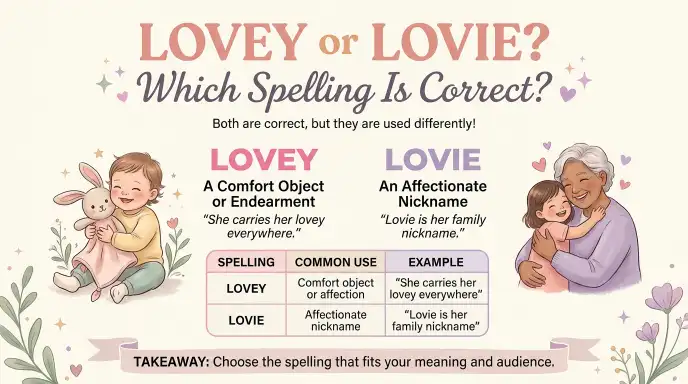
A lovey and a lovie are the same thing, a small, soft comfort blanket or toy that helps a baby feel safe, and the only real difference is spelling and brand usage.
If you are comparing a lovey vs a lovie, you are probably wondering which one to buy for your little one. This guide clears up the confusion in simple words.
Many parents think a lovie is different from a lovey, but both words describe the same cuddly comfort item. Some brands use “lovie” in product names, while “lovey” is the more common spelling.
What matters most is the material, size, and safety of the lovey or lovie you choose. Soft, breathable fabrics and secure stitching are the features to look for.
Experts advise keeping any lovey or lovie out of the crib until your baby is at least 12 months old, to follow safe sleep guidelines. You can use it during playtime, car rides, and cuddle time instead.
Defination:
A lovey, or lovie, is a soft security item that babies and toddlers cling to for comfort. It is usually small, made of gentle, breathable fabric, and often combines a blanket with a plush toy. Babies commonly form a strong bond with their lovey, using it to self-soothe during naps, travel, and new situations.
Lovey or Lovie: Quick Answer
Which spelling is correct?
Both lovey and lovie can be correct, but they are not always interchangeable.
- Lovey: The more established dictionary spelling for a loving term of address. It can also mean a baby’s favorite comfort object, such as a blanket or soft toy.
- Lovie: An alternative spelling often used as a personal nickname, affectionate name, or given name.
For example:
- “Good morning, lovey! I hope you slept well.”
- “My little girl takes her lovie everywhere.”
- “I bought a soft lovey for the new baby.”
- “Happy birthday, Lovie! I hope your day is full of joy.”
Lovey is a tender word people use to address someone they care about. Meanwhile, lovie refers to a snuggly comfort item, but lovey would be just as correct. Finally, Lovie is simply a person’s name.
Quick rule: Use lovey when you want the more established dictionary spelling. Use lovie when it is someone’s chosen nickname or preferred spelling. For a child’s comfort blanket, either form may appear, but lovey is a widely recognized choice.
The Origin of Lovey or Lovie:
Where do these words come from?
The word lovey comes from the word love and the affectionate ending -y. English speakers often add this ending to words to make them sound friendly, familiar, or loving.
For example, people use words such as sweetie, dearie, and doggy in informal speech. In a similar way, lovey developed as a warm way to address someone.
According to the historical information collected by Etymonline, lovey has been used as an affectionate name since around 1731. Historical dictionaries also record spelling forms such as lovy, lovee, and lovie. This shows that spelling variation has existed for a long time.
Why are there two spellings?
English has many words with different spellings that sound alike. In informal language, people may change a word’s ending to give it a personal or playful feel.
The endings -ey and -ie are both found in affectionate words and names. For instance, people may use different spellings for nicknames without changing how they say them.
Over time, lovie became a familiar alternative to lovey. Some people prefer it because it looks softer or more personal. Others choose it because it is part of a family nickname or a person’s name.
The key point is that the two spellings do not follow a strict British-versus-American rule. Their use depends more on meaning, personal preference, and context.
British English vs American English Spelling:
Is lovey British and lovie American?
Not exactly. The difference between lovey and lovie is not a standard British-versus-American spelling rule.
British dictionaries recognize lovey as an informal term of address. In American English, lovey is also used for a baby’s familiar soft toy or blanket. The spelling lovie can appear as an alternative, particularly in names and personal expressions.
The meaning may change depending on the situation, even when the spelling stays the same.
| Feature | Lovey | Lovie |
| Main use | Affectionate word or comfort object | Nickname, name, or affectionate word |
| Dictionary recognition | Established dictionary spelling | Recognized spelling variation |
| British English | Informal term of address | Possible personal or informal variation |
| American English | Common term for a child’s comfort object | Used as a nickname or alternative spelling |
| Formal writing | Rarely needed | Rarely needed |
| Personal names | Can be used as a name | Can be used as a name |
Examples from British and American English
In British English, someone might say, “Are you all right, lovey?” as a friendly way to address another person. This use is informal and may sound more natural in some regions or social settings than in others.
In American English, a parent might say, “Bring your lovey to bed.” Here, the word refers to a familiar blanket or soft toy that makes a young child feel safe.
These examples show why it is important to look at the meaning rather than assume that one spelling belongs to a particular country.
Which Spelling Should You Use?
Choose the spelling that fits your audience
The best spelling depends on what you want to say and who will read your words.
For American readers: Use lovey when writing about a baby’s comfort blanket or soft toy. It is also suitable as an affectionate word. If a person prefers lovie as a nickname, respect that choice.
For British readers: Use lovey when addressing someone affectionately in an informal setting. Remember that it may sound overly familiar if you use it with a stranger or in a formal workplace.
For readers in other English-speaking countries: Both spellings may be understood, but the meaning should be clear from the sentence. If you are writing for a broad audience, lovey is a practical choice for the established word.
For baby names and nicknames: Personal preference matters most. You can choose Lovie or Lovey based on the look, sound, and meaning you prefer.
For professional writing: Avoid both forms unless the context calls for an affectionate expression, a quotation, a name, or a child’s comfort object.
| Writing situation | Best choice | Reason |
| Describing a baby’s comfort blanket | Lovey | Widely recognized in American English |
| Addressing someone warmly in British English | Lovey | Established informal usage |
| Writing a personal nickname | Lovie or Lovey | Either can reflect personal preference |
| Writing a formal business email | Neither, usually | Both are informal |
| Referring to someone named Lovie | Lovie | Preserve the person’s chosen spelling |
| Writing a dictionary-style explanation | Lovey | More established dictionary form |
Common Mistakes with Lovey or Lovie:
Errors to avoid
Although these words are simple, people sometimes use them in ways that cause confusion.
1. Thinking that lovie is always wrong
This is not true. Lovie is a recognized spelling variation and can also be a person’s name. However, lovey is the more established dictionary form for the common affectionate word.
2. Assuming the spellings have completely different meanings
The meanings can overlap. Both forms may be used as affectionate expressions, and both can appear in personal nicknames. The sentence and the speaker’s intention help explain the meaning.
3. Treating lovey as a formal word
Lovey is informal. It may sound sweet between family members or close friends, but it may not suit a formal letter or a message to someone you do not know well.
4. Changing someone’s name spelling
If someone’s name is Lovie, do not change it to Lovey simply because the latter is more common in dictionaries. Personal names should follow the spelling chosen by the person.
5. Confusing lovey with lovey-dovey
The expression lovey-dovey describes people who show romantic affection in a very open or sometimes exaggerated way. It is a related expression, but it is not the same as using lovey to address someone.
Lovey or Lovie in Everyday Examples:
Emails, messages, social media, and formal writing
The best way to understand the difference is to see how each word works in real situations.
1. In text messages
These words can make a private message sound warm and personal.
- “Good night, lovey. Sleep well!”
- “I miss you, lovie. See you tomorrow.”
- “Thank you for always supporting me, lovey.”
- “You will always be my little lovie.”
In these examples, both spellings express affection. The choice depends on the writer’s style and the relationship between the people.
2. In family conversations
Parents and caregivers may use lovey when talking about a child’s favorite object.
- “Where is your lovey?”
- “Let’s wash your lovey before bedtime.”
- “Your little lovie is waiting in the crib.”
The word often refers to an object that gives a child comfort during sleep or when a parent is away.
3. On social media
People may use either spelling in captions, comments, and posts.
Examples:
- “A perfect day with my lovey.”
- “My little lovie makes every day brighter.”
- “Sending love to all my favorite people!”
If you are writing a caption, choose the form that matches your tone. You can also use the person’s name or a familiar nickname.
4. In news articles and blogs
Writers should use the word only when it fits the subject.
For example:
- “The child held a familiar lovey during the trip.”
- “She greeted her friend with the words, ‘Hello, lovey.’”
A news article should explain the meaning if readers may not know the term.
5. In formal writing
Neither spelling is usually needed in formal business or academic writing. Instead, use a clear word that fits the situation.
For example:
- Informal: “Please bring your lovey.”
- Clearer formal version: “Please bring the child’s comfort blanket.”
The second sentence is more direct and easier for a wide audience to understand.
Lovey or Lovie : Google Trends and Usage Data:
What can search trends tell us?
People search for lovey or lovie for different reasons. Some want a spelling correction, while others are looking for baby names, nicknames, or information about comfort toys.
However, it is important to separate likely search intent from measured search data. Without a verified comparison for a specific period and country, it would be misleading to claim that one spelling receives more searches worldwide.
Google Trends can help you compare interest in these terms. It reports relative search interest on a scale from 0 to 100, rather than showing exact search counts.
You can use google trends to compare the spellings by country and over time. Keep the same date range and location for each comparison. You can also check related search terms to understand what people want to know.
How might usage vary by country?
- United States: The word lovey is used for a child’s comfort object. Searches may also relate to parenting, baby products, and affectionate nicknames.
- United Kingdom: Lovey is an established informal term of address. Some people may search for its meaning or how to use it.
- Canada and Australia: English speakers may understand both forms, but personal preferences and local usage can differ.
- Other countries: People learning English may search for the correct spelling, meaning, or pronunciation.
These are examples of possible search contexts, not verified rankings by country.
What does this mean for writers?
If you are writing an article about this keyword, answer the main question early. Explain both spellings, give examples, and help readers choose the right form.
Do not claim that Google Trends proves one spelling is universally correct. Search interest and spelling accuracy are different things.
Lovey vs Lovie: Side-by-Side Comparison
Main differences at a glance
This table summarizes the key points to remember.
| Comparison point | Lovey | Lovie |
| Pronunciation | Usually /ˈlʌvi/ | Usually pronounced the same way |
| Relationship to love | Derived from love with an affectionate ending | A spelling variation associated with the same affectionate idea |
| Common purpose | Term of address or comfort object | Personal nickname, name, or affectionate term |
| Tone | Warm, informal, caring | Warm, informal, personal |
| Best general choice | The established dictionary spelling | A suitable choice when preferred personally |
| Main writing tip | Use it consistently and in the right context | Preserve it when it is a chosen name or nickname |
The most important difference is not how the words sound. It is how you intend to use them. A dictionary-style article will usually favor lovey, while a personal message may use either form.
FAQs:
Q1: What is the meaning of lovie?
A lovie is another spelling of lovey, a small, soft comfort blanket or toy that helps a baby or toddler feel safe and calm. It is also used as a term of endearment, and occasionally as a given name.
Q2: What does lovey mean?
Lovey means a soft security item, usually a small blanket, often with a plush animal head, that a baby holds for comfort. It can also be an affectionate nickname for someone you love, similar to “dear” or “sweetheart.”
Q3: How do you say “lovie”?
“Lovie” is pronounced LUV-ee, rhyming with “dovey.” The first syllable sounds like the word “love,” and the stress falls on that first syllable.
Q4: How do you say “lovey”?
“Lovey” is also pronounced LUV-ee. It sounds exactly the same as “lovie,” because the two words differ only in spelling.
Q5: What does “lovie” mean in slang?
In slang, lovie is a friendly term of endearment, similar to “love” or “dear,” especially in British English. Tone matters: between friends or family it sounds warm, but from a stranger it can sometimes come across as patronizing.
Q6: How do you spell “lovie”?
“Lovie” is spelled L-O-V-I-E. The alternative spelling “lovey” is spelled L-O-V-E-Y, and both are accepted, with “lovey” being the more common form for baby comfort items.
Q7: How do I spell “I love you”?
“I love you” is spelled I, L-O-V-E, Y-O-U. In texting, it is often shortened to “ILY.”
Q8: What is the name Lovie short for?
Lovie is usually used as a name in its own right or as a nickname. It is sometimes a short form of names like Lovina or Louvenia, but it does not have one single official origin.
Conclusion:
The choice between lovey or lovie becomes simple once you understand how each spelling is used. Both forms can express warmth and affection, but lovey is the more established dictionary spelling. It can describe an affectionate way to address someone and a child’s favorite comfort blanket or soft toy.
On the other hand, lovie is a useful alternative for personal nicknames and names. If someone prefers this spelling, there is no need to change it. The same rule applies to family nicknames, social media names, and other personal expressions.
For everyday writing, choose lovey when you want a widely recognized spelling. If you are writing about a person named Lovie, use that person’s actual name. If you are talking about a baby’s comfort object, lovey is a clear and familiar choice.
Remember that these words are informal. They can sound sweet between loved ones, but they may not suit every professional situation. Always consider your audience, the meaning you want to express, and the tone of your message.
Deep dive!





1 thought on “Lovey or Lovie: Which Spelling Is Correct?”