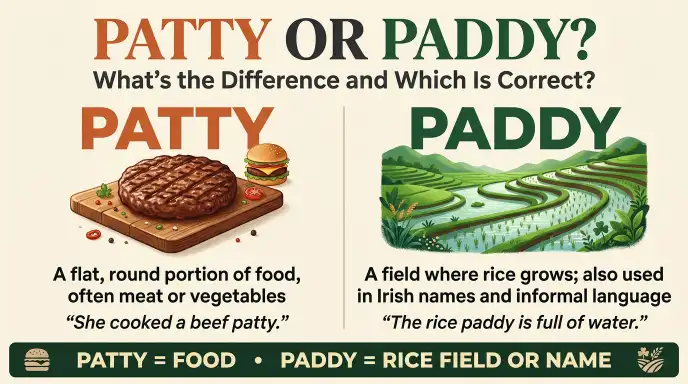
Patty or paddy? “Patty” is a flat cake of ground food, like a burger patty, while “paddy” means unhusked rice or the field where rice grows.
Many people mix up patty or paddy because the two words sound almost the same. Choosing the wrong one can confuse readers and hurt the quality of your writing.
A patty is a small, round, flat portion of minced meat, vegetables, or other food, usually fried or grilled. You will see it in burgers, veggie patties, and breakfast sausage patties.
A paddy, on the other hand, is linked to rice farming. It refers to a flooded field where rice is grown, or to raw rice that still has its husk on.
In this guide, we explain patty or paddy with clear examples so you never confuse them again. Keep reading to learn the meanings, correct usage, and easy tricks to remember each word.
Defination:
Patty is a small, flat, round cake of minced meat, vegetables, or other food, usually fried or grilled, like a burger patty.Paddy is a flooded field where rice is grown, or raw rice that still has its husk on.
Patty or Paddy : Quick Answer
The correct choice depends on what you want to say. Patty usually means a small, flat piece of food, while paddy usually refers to rice or a field where rice grows.
What Does Patty Mean?
A patty is a flat, round portion of food. It may be made from beef, chicken, fish, beans, or other ingredients.
Examples:
- I put a beef patty inside the burger bun.
- She made a potato patty for lunch.
- The restaurant serves a tasty chicken patty.
Patty can also be a person’s name. For example, Patty may be used as a short form of Patricia.
What Does Paddy Mean?
A paddy is most often linked to rice farming. It can mean a field used to grow rice or rice that has not been removed from its husk.
Examples:
- The farmers planted rice in the paddy field.
- The green paddy fields looked beautiful after the rain.
- The harvested paddy was ready for processing.
The word Paddy can also be a name or nickname for someone called Patrick.
Quick Comparison Table
| Word | Main meaning | Example |
| Patty | A flat piece of food | I cooked a burger patty. |
| Paddy | A rice field or unhusked rice | The paddy field was full of water. |
| Patty | A personal name | Patty called me yesterday. |
| Paddy | A name or nickname for Patrick | Paddy joined his friends. |
Remember this simple rule: patty is often about food served as a flat portion, while paddy is often about rice and farming.
The Origin of Patty or Paddy:
The words patty and paddy have different histories. Learning where they came from can help you understand why they have different meanings today.
Where Does the Word Patty Come From?
The word patty is linked to the French word pâté, which refers to a prepared food mixture or a dish made from chopped or minced ingredients. English developed the word patty for a small, flat portion of food.
Over time, the word became common in cooking. Today, people use it for burger patties, fish patties, chicken patties, and vegetarian patties.
The word also appears as a personal name. In this case, Patty is often a short form of Patricia. The food meaning and the personal name are separate uses of the same spelling.
Where Does the Word Paddy Come From?
The word paddy, when used for rice, comes through English from Malay padi, meaning rice in the husk or growing rice. This reflects the influence of Southeast Asian rice-growing regions on English vocabulary.
The term became useful in English when people needed words for rice crops and the fields where rice grows. Today, paddy field is widely used in discussions about farming, food production, and rural life.
In Ireland and other English-speaking communities, Paddy is also a familiar form of Patrick. This use has a different history from the word for rice.
Why Are Patty and Paddy So Easy to Confuse?
The two words have similar spellings. Each has five letters, begins with the letter p, and ends with the letter y. In some accents, their sounds may also seem close.
However, spelling is not based only on how a word sounds. The meaning and context matter, too.
For example:
- Correct: The chef cooked a beef patty.
- Correct: The farmer walked through the paddy field.
- Incorrect: The chef cooked a beef paddy.
The last sentence uses the wrong word if the writer means a flat piece of food.
British English vs American English Spelling:
Many English words have different spellings in British and American English. For example, British English often uses colour, while American English uses color. However, patty and paddy are not a British-versus-American spelling pair.
Both words are used in British and American English. The difference is in their meanings, not in the country where the writer lives.
How Are Patty and Paddy Used in Different Countries?
In the United States, patty is common in food-related phrases such as burger patty and chicken patty. The word paddy appears in farming discussions and in the name Patrick’s familiar form.
In the United Kingdom, people also use patty for food portions and paddy for rice fields or unhusked rice. The same basic difference applies in other English-speaking countries.
The table below shows how the words work in different English varieties.
| Feature | British English | American English |
| Flat piece of burger meat | Patty | Patty |
| Flat vegetable food portion | Patty | Patty |
| Field used to grow rice | Paddy field | Paddy field |
| Rice still in its husk | Paddy | Paddy |
| Short form of Patricia | Patty | Patty |
| Familiar form of Patrick | Paddy | Paddy |
Are There Any Regional Differences?
Yes. Some uses may be more common in one region than another because of local food, culture, and farming practices.
For example, rice farming terms are more familiar in countries where rice is a major crop. The phrase paddy field is common in discussions about agriculture in South Asia and Southeast Asia.
Likewise, the word patty is often used in menus and recipes in countries where burgers and similar foods are popular.
Still, these differences do not change the main rule. Use patty for a flat food portion and paddy for rice or a rice field.
Which Spelling Should You Use?
The best spelling depends on your meaning and your audience. Since patty and paddy have different meanings, you should first decide what you want to describe.
If You Are Writing for an American Audience
Use patty when talking about a burger or another flat food portion.
Examples:
- This burger has a grilled beef patty.
- I made a bean patty for my vegetarian friend.
- The restaurant sells chicken patties.
Use paddy when writing about rice farming, rice in its husk, or a person named Paddy.
If You Are Writing for a British or Commonwealth Audience
The same spelling rules apply in British English and much of the Commonwealth.
Examples:
- The café serves a spicy fish patty.
- The farmer works in the paddy fields.
- Paddy is a nickname for Patrick.
In countries such as Pakistan, India, and Bangladesh, readers may be familiar with paddy because rice farming is an important part of agriculture. However, patty is still the right word for a flat food portion.
If You Are Writing for a Global Audience
Use clear context so that readers understand your meaning.
For example, instead of writing, “I bought a patty,” you could write, “I bought a chicken patty for lunch.”
Instead of writing, “The workers entered the paddy,” write, “The workers entered the paddy field to harvest rice.”
These sentences give readers enough information to understand the words, even if they are not familiar with every regional use.
A Simple Rule to Remember
If you mean food shaped into a flat round portion, write patty.
If you mean rice in its husk or land where rice grows, write paddy.
Common Mistakes with Patty or Paddy:
People often confuse these words because they look alike. Fortunately, most mistakes are easy to fix once you know the meaning of each word.
Mistake 1: Writing Paddy Instead of Patty
Incorrect: I ordered a beef paddy at the restaurant.
Correct: I ordered a beef patty at the restaurant.
Why? A beef patty is the flat portion of beef used in a burger. Paddy does not have this meaning in standard English.
Mistake 2: Writing Patty Instead of Paddy
Incorrect: The farmer planted rice in the patty field.
Correct: The farmer planted rice in the paddy field.
Why? A paddy field is land used to grow rice. The word patty refers to a food portion, not a rice field.
Mistake 3: Assuming the Words Are Regional Spellings
Incorrect idea: Americans write patty, while British people write paddy.
Correct idea: Both spellings exist in British and American English, but they mean different things.
Do not choose one based only on your audience. Choose the word that matches your meaning.
Mistake 4: Confusing Names With Common Nouns
Patty and Paddy can both be personal names or nicknames.
Examples:
- Patty is visiting her family.
- Paddy is visiting his family.
When used as names, they should usually begin with a capital letter. When used as common nouns, they normally begin with a lowercase letter unless they appear at the start of a sentence.
Common Mistakes and Corrections Table
| Incorrect sentence | Correct sentence | Reason |
| I cooked a chicken paddy. | I cooked a chicken patty. | A flat food portion is a patty. |
| We walked through the patty field. | We walked through the paddy field. | A rice-growing field is a paddy field. |
| The burger needs a paddy. | The burger needs a patty. | A burger contains a patty. |
| The farmer harvested the patty. | The farmer harvested the paddy. | Paddy refers to rice in its husk or the crop. |
Patty or Paddy in Everyday Examples:
Both words appear in everyday communication, but they fit different topics. The following examples show how to use them correctly in emails, news, social media, and formal writing.
Patty in Emails
You might use patty when discussing a meal, a recipe, or a food order.
Examples:
- Could you buy burger patties for dinner?
- Please add one vegetable patty to my order.
- I tried your chicken patty recipe, and it was delicious.
These sentences are simple and clear. They use patty because they refer to food.
Paddy in Emails
Use paddy when discussing rice, farming, or agricultural work.
Examples:
- The farmer reported that the paddy crop was growing well.
- Please send the latest report on paddy production.
- The team visited the paddy fields yesterday.
These examples are useful in farming, food production, and agricultural business.
Patty and Paddy in News Reports
News reports often use patty in stories about restaurants, food prices, or cooking.
Example: “The restaurant introduced a new plant-based burger patty to its menu.”
News about agriculture may use paddy when discussing rice production, crop damage, or harvests.
Example: “Heavy rain affected paddy fields across the region.”
In both cases, the word helps readers understand the subject of the report.
Patty and Paddy on Social Media
On social media, people often use short sentences and casual language.
Examples using patty:
- Homemade burger patties taste better!
- This veggie patty is my new favorite.
Examples using paddy:
- The green paddy fields look beautiful after the rain.
- Farmers are preparing their paddy crops for harvest.
The meaning stays the same, even in informal posts.
Patty and Paddy in Formal Writing
In formal writing, use each word with care and explain it when your audience may not know the term.
Examples:
- “The study examined the nutritional value of plant-based patties.”
- “The report measured paddy production during the growing season.”
Do not replace one word with the other simply to avoid repeating it. Clear and accurate word choice is more important than variety.
Patty or Paddy : Google Trends and Usage Data:
People may search for patty or paddy when they are unsure about spelling, writing a recipe, reading about rice farming, or checking a name. However, the two words serve different purposes, so their search popularity may depend on the topic and location.
Which Word Is More Popular?
There is no single answer for every country or topic. Patty may attract searches related to burgers, recipes, restaurant menus, and personal names. Paddy may attract searches related to rice farming, crop production, agriculture, and the name Patrick.
The popularity of either term can change over time. Food trends, seasonal farming activity, news reports, and cultural events may all affect search interest.
How Does Search Interest Differ by Country?
In the United States and the United Kingdom, patty is commonly linked to food. In countries with large rice-growing industries, such as India, Bangladesh, and other parts of South and Southeast Asia, paddy may be more familiar in agricultural contexts.
These are general language patterns, not verified rankings of search volume. To compare actual interest, you would need current Google Trends data for the exact terms, a chosen time period, and selected countries.
How Can You Check Google Trends?
Follow these steps:
- Open Google Trends.
- Search for “patty” and “paddy” as separate terms.
- Choose the country you want to study.
- Select a time range, such as the past 12 months or five years.
- Compare the interest graph and related queries.
- Repeat the check for other countries if your website targets a global audience.
Remember that Google Trends reports relative search interest, not the exact number of searches. A higher score does not automatically mean that a word has more total searches than every other term.
What Does This Mean for Your Article?
If you are writing an article about patty or paddy, focus on answering the reader’s question directly. Explain both meanings, provide clear examples, and show how to avoid common errors.
Do not claim that one word is more popular worldwide unless you have reliable data to support that claim. Helpful explanations and accurate examples make the article more useful to readers.
Patty vs Paddy: Final Comparison Table:
This table brings the main differences together in one place.
| Comparison point | Patty | Paddy |
| Main meaning | A flat portion of food | Rice in its husk or a rice field |
| Common context | Cooking, burgers, recipes | Farming, rice production |
| Example phrase | Beef patty | Paddy field |
| Personal name use | Short form of Patricia | Familiar form of Patrick |
| British English | Correct spelling | Correct spelling |
| American English | Correct spelling | Correct spelling |
| Can the words be swapped? | No, not when referring to their usual meanings | No, not when referring to their usual meanings |
The key difference is meaning, not geography. Both spellings are correct English words, but they do different jobs.
FAQs:
Q1: Is it patty or paddy?
Both words are correct, but they have different meanings. “Patty” is a flat cake of ground food, like a burger patty. “Paddy” refers to rice, either unhusked rice grains or the flooded field where rice grows.
Q2: Is it patty or paddy burger?
The correct term is patty burger. The patty is the cooked disc of meat or vegetables inside the bun. “Paddy burger” is a common spelling mistake, because “paddy” relates only to rice.
Q3: What is the difference between paddy and patty?
A patty is a food item, usually round, flat, and cooked by frying or grilling. A paddy is connected to rice farming. You eat a patty in a burger, while paddy is the rice crop grown in a field before it is milled.
Q4: What does patty mean?
Patty means a small, flat, round portion of minced meat, fish, vegetables, or other food. Common examples are burger patties, veggie patties, and sausage patties. It can also be a short form of the name Patricia.
Q5: Is it patty or patti?
In English, the correct spelling is patty. “Patti” is mainly a personal name (like Patti Smith) or a word used in South Asian languages, where it can mean a leaf or a strip. For food in English, always use “patty.”
Q6: Why is it called a patty?
The word comes from the French word “pâté,” meaning a small pie or pastry. Over time, “patty” came to describe any small, flat, round cake of food, which is why we use it for burgers today.
Q7: What is a patty in slang?
In everyday slang, “patty” is a casual nickname for a girl named Patricia. In some regions, it also refers to a savory pastry, such as a Jamaican beef patty. “Paddy,” on the other hand, can be offensive when used as a slang term for Irish people, so it is best avoided in that sense.
Q8: What does patty stand for?
Patty does not stand for anything. It is not an acronym or abbreviation. It is simply a regular English word for a flat cake of food.
Conclusion: Patty or Paddy?
The difference between patty or paddy is simple once you understand what each word means. Both are correct English words, but they are used in different situations. Patty usually refers to a small, flat portion of food, such as a beef patty, chicken patty, or vegetable patty. It can also be a personal name, often used as a short form of Patricia.
Paddy usually refers to rice in its husk or a field where rice grows. You may see it in phrases such as paddy field, paddy crop, and paddy production. It can also be a familiar name for Patrick.
Another important point is that these words are not British and American spelling variations. Both are used in British and American English. Therefore, your choice should depend on the meaning you want to express, not the country you are writing for.
When in doubt, check the sentence. If you are talking about a burger or a flat food portion, use patty. If you are talking about rice or rice farming, use paddy. By following this rule and checking your examples, you can avoid common spelling mistakes and write with greater confidence.
Key Insights!









5 thoughts on “Patty or Paddy: What’s the Difference and Which Is Correct?”