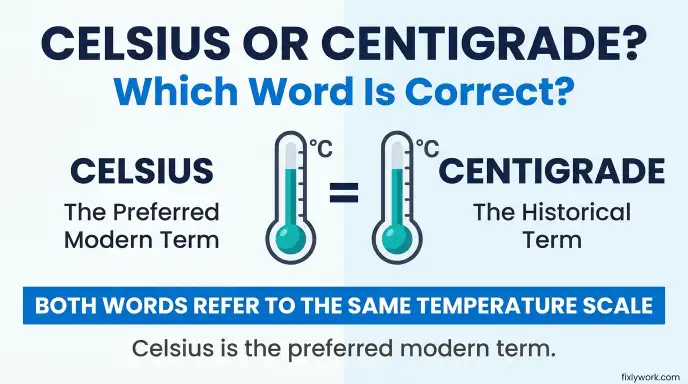
Celsius and centigrade refer to the same temperature scale, but “Celsius” is the official name used today, while “centigrade” is the older term.
The scale was created by Swedish astronomer Anders Celsius in 1742. It sets the freezing point of water at 0 degrees and the boiling point at 100 degrees, making it simple and easy to use in daily life.
The name “centigrade” comes from Latin words meaning “hundred steps,” because the scale is divided into 100 equal parts. For many years, both names were used interchangeably in schools, books, and weather reports.
In 1948, the international scientific community officially adopted “Celsius” as the standard name. This was done to honor the inventor and to avoid confusion with a unit of angle measurement used in some European countries.
In this article, we will explore the difference between Celsius and centigrade, their history, and which term you should use. Whether you are a student, a writer, or just curious, this guide will give you a clear and simple answer.
Defination!
Celsius is the official name of the temperature scale where water freezes at 0 degrees and boils at 100 degrees. It is named after the Swedish astronomer Anders Celsius.
Centigrade is the older name for the same scale, meaning “hundred steps” in Latin. It is no longer the official term, but people still use it in everyday speech.
Celsius or Centigrade : Quick Answer
Which Word Is Correct?
Both Celsius and centigrade are correct when referring to the familiar temperature scale used in most countries. The main difference is that Celsius is the modern official name, while centigrade is an older term that people still use.
For example:
- “The temperature is 25 degrees Celsius.”
- “The temperature is 25 degrees centigrade.”
- “Water freezes at 0°C.”
- “Water boils at 100°C under standard atmospheric pressure.”
All four examples refer to the same temperature scale.
Today, Celsius is the better choice for schoolwork, scientific reports, weather reports, and professional writing. It is also the name used in the International System of Units (SI).
Is There Any Difference Between Celsius and Centigrade?
In normal use, there is no difference in the temperatures they describe. Both terms refer to the same scale.
The difference is mainly in their names and history. The word “centigrade” describes a scale divided into 100 degrees between two reference points. The word “Celsius” honors the Swedish scientist Anders Celsius.
Easy rule: Use Celsius in modern writing. You can still understand and use centigrade when you hear it in conversation.
The Origin of Celsius and Centigrade:
Where Does the Word Celsius Come From?
The word Celsius comes from Anders Celsius, a Swedish astronomer who lived from 1701 to 1744. He developed a temperature scale in 1742.
His original scale worked in the opposite direction from the scale used today. In Celsius’s original version, 0 represented the boiling point of water, while 100 represented its freezing point under the conditions he used.
After his death, the scale was reversed. The version that became widely used places the freezing point of water at 0 and the boiling point at 100 under standard atmospheric pressure.
The name Celsius honors his contribution to temperature measurement.
Today, Celsius is used around the world in weather reports, education, science, cooking, and many other areas.
Where Does the Word Centigrade Come From?
The word centigrade comes from terms linked to one hundred and degrees. “Centi-” means one hundredth, while “grade” relates to a division or step.
The name describes a scale with 100 degrees between the freezing and boiling points of water.
Centigrade became a common name for the scale because of this 100-degree interval. For many years, people used the term in everyday conversation and scientific writing.
However, the name did not identify the scientist who created the original scale. As the Celsius name became the international standard, centigrade gradually became less common in formal use.
Why Did the Name Change?
The change helped make temperature terminology clearer and more consistent around the world.
In 1948, the name Celsius was adopted internationally for the temperature scale. The change also helped avoid confusion with other uses of the word “centigrade,” including older measurement systems that divided angles into 100 parts per right angle.
Although the two names still mean the same thing when discussing temperature, Celsius is now preferred in scientific and technical work.
This is why modern textbooks and scientific organizations generally use Celsius rather than centigrade.
British English vs American English Spelling:
Do British and American English Use Different Words?
No. Celsius is spelled the same way in British English and American English. Centigrade is also spelled the same way in both varieties.
The difference is not about spelling. It is more about personal preference, age, context, and writing style.
| Feature | British English | American English |
| Modern term | Celsius | Celsius |
| Older term | Centigrade | Centigrade |
| Symbol | °C | °C |
| Common formal usage | Celsius | Celsius |
| Everyday usage | Both may occur | Both may occur |
| Preferred scientific term | Celsius | Celsius |
Which Term Is More Common in Each Country?
Celsius is the standard term in the United Kingdom, the United States, and many other countries when discussing the metric temperature scale. However, people may still use centigrade because they learned the older name at school or heard it from family members.
The United States also uses Fahrenheit widely in daily life. This means that some Americans may be more familiar with Fahrenheit than Celsius or centigrade.
In the UK, Australia, Canada, and many other countries, Celsius is widely used for weather reports and daily temperatures.
The main point is that regional differences in temperature habits do not change the meaning of Celsius and centigrade.
How Should You Write the Temperature Symbol?
The standard symbol for degrees Celsius is °C.
Examples:
- 0°C
- 20°C
- 37°C
- 100°C
In formal writing, you can also spell out the unit:
- 20 degrees Celsius
- 37 degrees Celsius
The degree symbol is placed before the letter C. Do not write “C°” when you mean degrees Celsius.
Which Spelling Should You Use?
For American Readers
If you are writing for an American audience, use Celsius when discussing the metric temperature scale. This is especially helpful in scientific, educational, and international contexts.
For example:
“The temperature reached 30 degrees Celsius.”
In everyday American life, Fahrenheit is often more familiar. If your readers may not understand Celsius, you can give both measurements.
For example:
“The temperature reached 30°C (86°F).”
This makes the information easier to understand without changing the meaning.
For Readers in the UK and Commonwealth Countries
If you live in the UK, Australia, New Zealand, Canada, or another country that commonly uses Celsius, the current term is usually the safest option.
For example:
“Water freezes at 0°C.”
You may still hear older speakers say centigrade, and the word is easy to understand. However, Celsius is the clearer choice for modern articles, schoolwork, and professional documents.
For a Global Audience
If your article is intended for readers worldwide, use Celsius as your main term. It is widely recognized and follows modern scientific practice.
You can mention centigrade once to help readers who know the older name.
For example:
“Celsius, also known as centigrade in older usage, is a temperature scale in which water freezes at 0°C under standard conditions.”
After that, use Celsius throughout the article.
Advice for Students and Writers
For school assignments, science projects, laboratory reports, and professional documents, choose Celsius. It is the standard term and helps keep your writing consistent.
If a teacher, textbook, or older source uses centigrade, you do not need to assume that it is wrong. Instead, understand that it refers to the same temperature scale in this context.
Common Mistakes with Celsius or Centigrade:
Mistake 1: Thinking They Are Two Different Scales
Some people think Celsius and centigrade measure different temperatures.
Incorrect idea: “20°C is not the same as 20 degrees centigrade.”
Correct understanding: Both describe the same temperature on the same scale.
Mistake 2: Using Centigrade in Every Formal Document
Centigrade is an understood term, but Celsius is preferred in modern scientific and technical writing.
Less suitable for a modern scientific report:
“The sample was heated to 80 degrees centigrade.”
Better:
“The sample was heated to 80 degrees Celsius.”
The second sentence uses the current standard name.
Mistake 3: Writing the Symbol Incorrectly
The correct symbol is °C.
Correct: “The room was 22°C.”
Incorrect: “The room was 22C°.”
The degree sign comes before the letter C.
Mistake 4: Confusing Celsius With Fahrenheit
Celsius and Fahrenheit are different temperature scales. Celsius and centigrade, in modern use, are two names for the same scale.
| Temperature event | Celsius | Fahrenheit |
| Water freezes | 0°C | 32°F |
| Cool room temperature | 18°C | 64.4°F |
| Body temperature reference | About 37°C | About 98.6°F |
| Water boils | 100°C | 212°F |
These values assume standard reference conditions where relevant. Human body temperature can vary from person to person.
Mistake 5: Assuming Water Always Boils at Exactly 100°C
Water boils at 100°C under standard atmospheric pressure. At higher elevations, air pressure is lower, so water can boil at a lower temperature.
For everyday writing, saying that water boils at 100°C is usually fine. For science work, include the pressure conditions when they matter.
Celsius or Centigrade in Everyday Examples:
In Emails
Use Celsius in work emails, school messages, and other written communication.
Examples:
- “The room temperature should remain near 20°C.”
- “The forecast says it will reach 32 degrees Celsius.”
- “Please store the sample below 5°C.”
These examples are clear and suitable for professional use.
In News and Weather Reports
Modern weather reports usually use Celsius in countries that use the metric temperature scale.
Examples:
- “The temperature will reach 28°C this afternoon.”
- “The overnight low is expected to fall to 4°C.”
- “The city recorded a temperature of 35 degrees Celsius.”
Centigrade may appear in older news reports or casual speech, but Celsius is the modern standard.
On Social Media
People often use short forms when discussing temperature online.
Examples:
- “It is 40°C today!”
- “I prefer weather around 22°C.”
- “Is 15°C too cold for a walk?”
The symbol °C is useful when space is limited. If your readers may not know the symbol, spell out the unit.
In Formal and Scientific Writing
Scientific writing should use precise terms and standard units.
Examples:
- “The solution was cooled to 5°C.”
- “The test was performed at 25 degrees Celsius.”
- “The temperature increased from 10°C to 60°C.”
Use the same style throughout the document. If you are following a journal, school, or laboratory style guide, follow its formatting rules.
In Cooking and Baking
Celsius is common in recipes in many countries.
Examples:
- “Preheat the oven to 180°C.”
- “Bake the cake at 160°C.”
- “Heat the mixture to 90°C.”
Some older recipes may say centigrade, but you can read that as Celsius when it refers to the standard temperature scale.
Celsius or Centigrade : Google Trends and Usage Data:
Which Term Do People Search For More?
Celsius is the preferred modern term, while centigrade remains familiar to many people. However, the exact number of searches for each word can change over time and across countries.
It would not be accurate to claim a specific search winner without checking current search data. The words may also appear in different types of searches. For example, a student might search “Celsius or centigrade,” while a cook may search “180 degrees centigrade.”
These searches do not always reflect the same user need.
How Can You Compare Search Interest?
You can use Google Trends to compare the terms.
- Open Google Trends.
- Search for “Celsius” and “centigrade.”
- Choose a country or select worldwide results.
- Pick a time range, such as the past 12 months or five years.
- Compare the interest shown for both terms.
- Review related queries to understand what people want to learn.
Google Trends uses a normalized scale from 0 to 100. It shows relative search interest, not the exact number of searches.
What Do Search Trends Mean for ?
If you are writing an article about “Celsius or centigrade,” answer the main question early. Readers usually want to know if the terms differ and which one they should use.
Include helpful related topics, such as the history of the names, temperature symbols, examples, and the difference between Celsius and Fahrenheit.
Do not repeat the keyword in every paragraph. Use it naturally in the title, introduction, and relevant headings. Add related phrases only when they help explain the topic.
No article can guarantee a top Google ranking. Clear answers, accurate information, useful examples, and a good reading experience are better goals than keyword repetition.
Comparison Table: Celsius, Centigrade, and Fahrenheit:
The three terms are related, but they do not all mean the same thing.
| Term | What it means | Modern status | Example |
| Celsius | A temperature scale named after Anders Celsius | Official modern term | 25°C |
| Centigrade | An older name for the Celsius scale | Still understood, but less preferred | 25 degrees centigrade |
| Fahrenheit | A separate temperature scale | Widely used in the United States | 77°F |
Remember: Celsius and centigrade refer to the same scale in modern use. Fahrenheit is a different scale, so the numerical values are not the same.
FAQs:
Q1: Do British say Celsius or centigrade?
Most British people say “Celsius” today, especially in weather reports, schools, and official documents. However, “centigrade” is still heard in casual speech, mostly among older generations who grew up using the term.
Q2: Why is centigrade now called Celsius?
In 1948, the international scientific community officially renamed the scale “Celsius” to honor its inventor, Anders Celsius. The change also avoided confusion, because “centigrade” was already used in some European languages for a unit of angle measurement.
Q3: What is Celsius used for?
Celsius is used to measure temperature in weather forecasts, cooking, medicine, science, and daily life. It is the standard temperature scale in almost every country in the world, except the United States and a few others that mainly use Fahrenheit.
Q4: Is Celsius equal to centigrade?
Yes, they are exactly the same scale. Water freezes at 0 degrees and boils at 100 degrees on both. The only difference is the name: “Celsius” is the official term, and “centigrade” is the older one.
Q5: Is it better to say Celsius or centigrade?
It is better to say “Celsius.” It is the official name recognized by scientists, schools, and international organizations. “Centigrade” is not wrong, but it sounds outdated and is rarely used in modern writing.
Q6: Is 25 degrees centigrade hot?
No, 25°C is generally considered warm and comfortable, not hot. It is about 77°F, which is pleasant weather for most people. It can feel hot if the humidity is high or if you are in direct sunlight.
Conclusion:
When choosing between Celsius or centigrade, the best option for most modern writing is Celsius. Both terms refer to the same temperature scale, but Celsius is the official name used in science, education, and professional communication.
Centigrade is an older name that describes the 100-degree interval between the freezing and boiling points of water under standard atmospheric pressure. You may still hear it in conversation or find it in older books. That does not mean the speaker or writer is always wrong.
The key is to understand the difference between the names and the scales. Celsius and centigrade mean the same thing in modern use, while Fahrenheit is a separate scale with different numerical values.
For schoolwork, scientific reports, websites, and formal documents, use Celsius and write the symbol correctly as °C. If your audience is unfamiliar with the metric system, you can also provide the Fahrenheit equivalent.
For writers, explain the answer clearly, use examples that match the reader’s needs, and avoid unsupported claims about search popularity. A useful article should help readers understand the topic without making a simple question more confusing. Above all, choose clear wording and use it consistently.
Explore More!

I’m James Mitchell, a language and content writer focused on grammar, spelling, word usage, and everyday English. I enjoy making confusing words and common language questions simple and easy to understand.