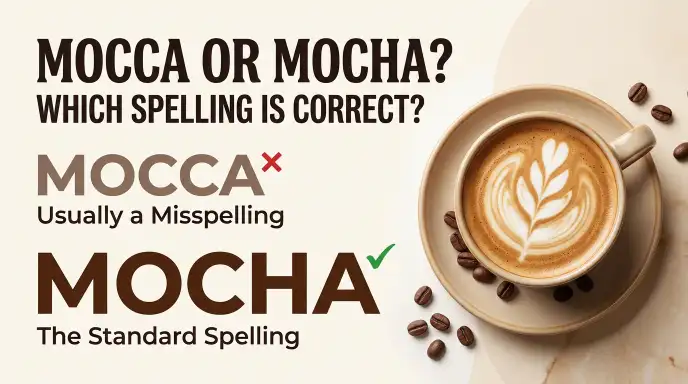
Mocha is the correct and standard spelling, while “mocca” is a common misspelling or a regional variant used in some brands and languages.
Mocha is a popular coffee drink made by combining espresso, steamed milk, and chocolate syrup or cocoa powder. It offers the rich bitterness of coffee along with the sweetness of chocolate, which is why it is loved worldwide.
The word “mocha” also comes from the Yemeni port city of Mocha, once a major hub of the global coffee trade. The city gave its name to a type of coffee bean and later to the chocolate-flavored coffee we enjoy today.
You may also see “mocca” on café menus, product labels, and websites, especially in European countries where spelling differs. Despite the variation, both spellings usually point to the same chocolate-coffee flavor.
In this article, we will explore the difference between mocha and mocca, their origins, and how to choose the right one. Whether you are a coffee lover or a curious reader, this guide will clear up all your confusion.
Defination!
Mocha is a coffee drink made with espresso, steamed milk, and chocolate. It is also the correct and standard spelling.
Mocca or Mocha : Quick Answer
Which spelling is correct?
Mocha is the standard English spelling for the coffee drink, coffee flavor, and chocolate-coffee combination.
For example:
- Correct: I ordered a mocha at the coffee shop.
- Correct: She loves mocha ice cream.
- Correct: Would you like a mocha latte?
- Usually incorrect for the drink: I ordered a mocca.
The spelling mocca may still appear in a business name, product name, or historical reference. In those cases, keep the spelling used by the official name or source.
What does mocha mean?
The word mocha has several related uses.
- Coffee drink: Espresso or strong coffee mixed with chocolate and milk.
- Flavor: A mix of coffee and chocolate.
- Coffee history: A word linked to Mocha, a historic port in Yemen that was known for its coffee trade.
- Color: A warm brown shade, often used to describe hair, paint, fabric, or other products.
For example, “I bought a mocha-colored sofa” uses mocha to describe a shade of brown. It does not refer to a drink.
Is mocca ever correct?
It can be correct as part of a proper name or a specific brand spelling. However, if you are writing about the drink or flavor in standard English, choose mocha.
The Origin of Mocca or Mocha:
Where does the word mocha come from?
The word mocha is linked to the port city of Mocha in Yemen. For many years, the port played an important role in the coffee trade.
Coffee from Yemen became known in international markets through this trading history. The name of the port became associated with coffee, and the word later developed a wider meaning in English.
Today, mocha can refer to coffee, a coffee-and-chocolate drink, or a brown color.
How did mocha become a coffee term?
Coffee from Yemen was traded across regions and reached European markets. The name Mocha became familiar to people who bought and sold coffee.
Over time, the word became associated with a style of coffee and, later, with drinks that combine coffee and chocolate. Modern cafés commonly use mocha for a drink made with espresso, chocolate, and milk.
For example:
- I drink a mocha every Friday.
- The café has a new mocha drink.
- This cake has a rich mocha flavor.
The meaning depends on the context, but the standard spelling remains mocha.
Why do people write mocca?
There are a few reasons why mocca appears in writing.
First, people may spell the word based on how it sounds. Since mocca and mocha are often pronounced similarly in English, the difference is easy to miss.
Second, some businesses use unusual spellings to create a unique brand name. A company may choose Mocca for its café, product, or website name.
Third, older texts or names from other languages may use different forms. A spelling found in a brand or historical source does not automatically become the standard spelling in English.
If you are writing a general article, menu, or recipe, use mocha unless you are referring to a specific name that uses Mocca.
British English vs American English Spelling:
Is mocha spelled differently in British and American English?
No. British English and American English both use mocha for the coffee drink and its related flavor.
Unlike words such as colour and color, this word does not have a standard British and American spelling difference.
Examples:
- British English: I would like a mocha, please.
- American English: I would like a mocha, please.
- British English: She made a mocha cake.
- American English: She made a mocha cake.
All these sentences use the standard spelling.
Comparison table: British English vs American English
| Use | British English | American English |
| Coffee drink | Mocha | Mocha |
| Coffee and chocolate flavor | Mocha | Mocha |
| Brown shade | Mocha | Mocha |
| Spelling of the drink | Mocha | Mocha |
| Mocca as a brand name | Depends on the brand | Depends on the brand |
Does pronunciation change the spelling?
Not usually. English speakers may pronounce mocha in slightly different ways, but the spelling stays the same.
The “ch” in mocha sounds like a “k,” not like the “ch” in chair. This is one reason the word may seem unusual to people who are learning English.
For example, mocha sounds roughly like “MOH-kuh.” Knowing this can help you recognize the word when ordering coffee or reading a menu.
Which Spelling Should You Use?
If your readers are in the United States
Use mocha when writing about coffee, chocolate-coffee flavor, or the brown shade.
Examples:
- I ordered a mocha with oat milk.
- This recipe makes a rich mocha brownie.
- The bedroom walls are painted mocha brown.
If a café or product uses Mocca as its official name, keep that spelling when referring to that business or product.
If your readers are in the United Kingdom
The same rule applies. British English uses mocha for the drink and flavor.
Examples:
- Can I have a mocha, please?
- We made mocha cupcakes for the party.
- She chose a mocha shade for the living room.
There is no need to change the spelling for a British audience.
If your readers are from different countries
Use mocha because it is the standard and widely recognized English spelling.
If you are writing a recipe, explain the flavor in simple words. For example:
“Mocha is a coffee and chocolate flavor that works well in cakes, cookies, and drinks.”
This helps readers who may know the word only from coffee menus.
What if you are writing a brand name?
Always check the official spelling. If a company uses Mocca in its registered or public name, do not silently change it to Mocha.
Proper names can use creative spellings. General English writing, however, should follow standard spelling rules.
Common Mistakes with Mocca or Mocha:
Mistake 1: Using mocca for a coffee drink
Incorrect: I ordered a mocca with extra chocolate.
Correct: I ordered a mocha with extra chocolate.
Use mocha when referring to the usual coffee drink.
Mistake 2: Thinking mocha means only coffee
The word can refer to a coffee drink, but it is also used for a coffee-and-chocolate flavor and a brown shade.
Examples:
- She ordered a mocha. (A drink)
- I baked a mocha cake. (A flavor)
- He bought a mocha jacket. (A color)
Always look at the surrounding words to understand the meaning.
Mistake 3: Confusing mocha with regular hot chocolate
A mocha usually contains coffee and chocolate, often with milk. Hot chocolate is generally made with chocolate or cocoa and milk or water, without coffee.
For example:
- I ordered a mocha because I wanted coffee and chocolate.
- My friend ordered hot chocolate without coffee.
Recipes and café menus may vary, so check the ingredients if you need to avoid caffeine.
Mistake 4: Assuming mocca is the British spelling
This is not correct. British English uses mocha, just like American English.
Do not use mocca simply because you are writing for a UK audience.
Mistake 5: Changing an official brand name
Incorrect: The café is called Mocha, when its official name is Mocca.
Correct: The café is called Mocca.
When a spelling is part of an official business name, use the business’s chosen form. The standard spelling for the drink remains mocha.
Mistake 6: Spelling mocha with “ch” as in chair
The word mocha is pronounced with a “k” sound for the “ch.” The spelling may look unusual, but it is standard English.
A simple way to remember it is to connect mocha with coffee menus, chocolate, and the historic coffee trade.
Mocca or Mocha in Everyday Examples:
In emails
Use mocha in everyday messages about coffee orders, events, and food.
Examples:
- Could you please order me a mocha?
- We will serve mocha cupcakes at the office event.
- The café has added a new mocha drink to its menu.
These sentences are clear and use the standard spelling.
In news and articles
Food writers and lifestyle publications often use mocha when discussing coffee, desserts, or color trends.
Examples:
- The café has launched a new iced mocha.
- Mocha desserts are popular with coffee lovers.
- Mocha brown is a warm shade used in home design.
Use the meaning that fits the topic.
On social media
People often use the word in coffee photos, recipes, and product posts.
Examples:
- Starting the day with a mocha!
- These mocha cookies are so good.
- I love this mocha color for autumn outfits.
For a business post, double-check the spelling before publishing it.
In formal writing
In menus, recipes, reports, and product descriptions, mocha is the best general choice.
Examples:
- The menu includes a hot mocha made with espresso and chocolate.
- This recipe uses cocoa powder and coffee to create a mocha flavor.
- The product is available in a soft mocha-brown finish.
If you are referring to a specific brand called Mocca, use its official name.
Comparison table: Mocca vs Mocha
| Feature | Mocca | Mocha |
| Standard English spelling for the drink | No | Yes |
| Coffee and chocolate flavor | Not the usual spelling | Yes |
| Brown color description | Not the usual spelling | Yes |
| May appear in a brand name | Yes | Yes |
| Used in British and American English | Only in specific names or sources | Yes |
| Best choice for a general article | No | Yes |
Mocca or Mocha: Google Trends and Usage Data:
Why do people search for mocca or mocha?
People may search for this phrase when they are unsure about the spelling. Others may want to know if mocca and mocha refer to different drinks, products, or colors.
Searchers may also be checking a menu, preparing a recipe, writing a product description, or learning English.
The best article should answer the spelling question first, then explain the meanings and uses of the correct form.
Which countries may search for mocha?
The word is relevant in countries where coffee shops, café menus, and coffee-based recipes are common. This may include the United States, the United Kingdom, Canada, Australia, and many other regions.
However, this does not confirm which country has the highest search interest for the exact phrase “mocca or mocha.” That would require a live comparison using Google Trends.
How can Google Trends help?
Google Trends shows relative search interest over time and across locations. Its scale ranges from 0 to 100, with 100 representing the highest relative interest within the selected search and time settings.
You can compare these terms:
- Mocca or mocha
- Mocha meaning
- Mocha coffee
- Mocca spelling
- Mocha vs mocca
The comparison may help you understand if people are more interested in the word’s meaning, its spelling, or the drink itself.
How can you use the data for SEO?
Start with the reader’s main question. Explain that mocha is the standard spelling, then cover related meanings, examples, and common mistakes.
You can also use natural variations such as “is it mocca or mocha?” and “how do you spell mocha?” where they fit the content.
Do not make up search numbers or claim that a keyword will guarantee a top Google ranking. Useful information, accurate spelling, a clear layout, and a good reader experience are better goals.
FAQs:
Q1: Are Mocca and mocha the same?
Yes, in most cases they mean the same thing. “Mocha” is the standard English spelling, while “mocca” is a variant used on some café menus, product labels, and in European countries. Both usually refer to a chocolate-flavored coffee.
Q2: What is the difference between mocha and macha?
Mocha is a coffee drink made with espresso, steamed milk, and chocolate. Macha (usually spelled “matcha”) is a finely ground green tea powder from Japan. Mocha tastes rich and chocolatey, while matcha tastes earthy, grassy, and slightly bitter.
Q3: Is it mocha or mokka?
Both are correct, depending on the language. “Mocha” is the English spelling, while “mokka” is used in German, Dutch, Swedish, and several other languages. They all refer to the same coffee flavor.
Q4: Why is it called Mocca?
The name comes from the port city of Mocha in Yemen, which was a major center of the coffee trade for centuries. The spelling “mocca” is simply a regional variation of the same name, which is why you see it in many European countries.
Q5: Is it pronounced mocha or mocca?
Both spellings are pronounced the same way: “MOH-kuh.” The double “c” in “mocca” does not change the sound, so you can say it the same way for either word.
Q6: What flavour is mocca?
Mocca tastes like a blend of coffee and chocolate. It has the bold, slightly bitter flavor of espresso, balanced by the sweetness of cocoa or chocolate syrup. Some versions also have a creamy, milky taste.
Conclusion:
When deciding between mocca or mocha, choose mocha for the coffee drink, coffee-and-chocolate flavor, and warm brown color. It is the standard spelling in both British and American English, so you do not need to change it for different audiences.
The spelling mocca may appear in brand names, product names, or certain older sources. If you are referring to a specific business that uses that spelling, keep its official name. Otherwise, mocha is the clear and familiar choice.
Remember that the word has a long connection to the historic port of Mocha in Yemen, which played an important role in the coffee trade. Today, the term appears on café menus, in recipes, in fashion descriptions, and in home design.
If you are writing an article, menu, email, or social media post, use the standard spelling and give enough context to make the meaning clear. For example, “mocha coffee” describes a drink, while “mocha brown” describes a color.
In short, mocha is the best choice for everyday English. Learning this small spelling difference will help you write more clearly and avoid common errors.
Discover more about!






1 thought on “Mocca or Mocha: Which Spelling Is Correct?”