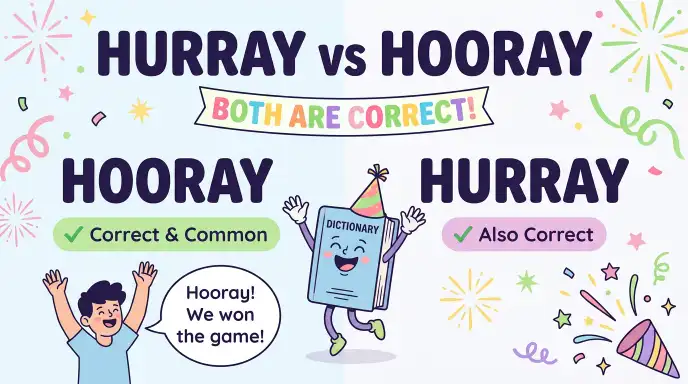
“Hurray” and “hooray” are both correct spellings of the same word, an exclamation of joy, and “hooray” is slightly more common.
Both words are used to cheer, celebrate, or show excitement, as in “Hooray, we won!” or “Hurray, it’s the weekend!” The meaning is exactly the same, so you can use either one.
Dictionaries list both spellings, and there is also a third version, “hurrah,” which is a little older and more formal. The choice usually depends on personal style or the spelling a writer prefers.
Many people worry that one of them is a mistake, but neither is wrong. What matters is staying consistent and using the same spelling throughout your writing.
In this article, we explain the difference between hurray and hooray, where they came from, and how to use them. By the end, you will pick the right spelling with confidence.
Hurray or Hooray : Quick Answer
Are Hurray and Hooray Both Correct?
Yes, both hurray and hooray are correct spellings. They are exclamations used to express happiness, excitement, approval, or victory.
An exclamation is a word or phrase that shows a strong feeling. These words often appear with an exclamation mark because they express excitement.
For example:
- Hooray! We passed our exams.
- Hurray! Our team won the final.
- Hooray! It is time for the holidays.
- Hurray! We finally finished the project.
Both spellings have the same basic meaning. You can use either one when you want to celebrate good news or show support.
However, “hooray” is a familiar choice in modern everyday writing. If you are unsure which spelling to use, choose “hooray.” It is a clear and widely understood option.
Remember that neither spelling is automatically wrong. The most important thing is to use your chosen spelling consistently.
The Origin of Hurray or Hooray:
Where Do These Words Come From?
The words “hurray” and “hooray” belong to a group of English exclamations used to express joy and approval. They are closely related to words such as “hurrah” and “hoorah.”
People have used these kinds of cries to celebrate victories, cheer for others, and show excitement at public events. For example, a crowd might shout a cheer when a team wins a match or a performer finishes a great show.
The exact history of these spellings is not completely clear. They developed through different written forms of similar cheering sounds. As a result, more than one spelling became accepted in English.
The word “hurrah” is another related form. It has a long history as a cheer, especially in group celebrations and public events. Over time, people also used forms such as “hurray” and “hooray.”
Why Are There Two Spellings?
English has many words with different spellings that express the same meaning. Sometimes, these differences develop through changes in pronunciation, writing habits, and common usage.
The same idea applies here. People have written cheering sounds in different ways, and more than one form has remained in use.
Consider these examples:
- “Hooray!” sounds cheerful and natural in everyday writing.
- “Hurray!” also shows excitement and happiness.
- “Hurrah!” is another accepted form of a celebratory cheer.
These words are not usually different in meaning. Instead, they offer different ways to write the same kind of expression.
British English vs American English Spelling:
Is Hurray British and Hooray American?
Many English learners believe that one spelling belongs to British English and the other belongs to American English. However, there is no strict rule that makes “hurray” British and “hooray” American.
Both spellings can be understood in the United States, the United Kingdom, and other English-speaking regions. Their use depends more on personal preference and writing habits than on national spelling rules.
This is different from words such as “colour” and “color,” where British and American English commonly use different spellings.
Here is a simple comparison.
| Feature | Hurray | Hooray |
| Meaning | Joy, excitement, or approval | Joy, excitement, or approval |
| Correct spelling | Yes | Yes |
| American English | Understood and used | Understood and used |
| British English | Understood and used | Understood and used |
| Common use | Celebrations and cheering | Celebrations and cheering |
| Best advice | Use consistently | A good everyday choice |
Examples in British and American English
Both forms work in sentences used in either variety of English.
American English:
- Hooray! We won the championship.
- Hurray! School is out for summer.
British English:
- Hooray! Our team has won the match.
- Hurray! The school trip is finally here.
Notice that the spelling choice does not change the meaning of either sentence.
If you write for a British or American audience, focus on clear wording and consistency. You do not need to change “hurray” to “hooray” just because your readers live in a particular country.
Which Spelling Should You Use?
Choosing the Best Word for Your Audience
Although both forms are correct, you may still want to choose one for your writing. The best option depends on where and how you plan to use it.
For American readers: “Hooray” is a familiar and suitable choice for everyday messages, school writing, and social media posts. “Hurray” is also acceptable.
For British readers: You can use either form. British English does not require you to choose “hurray” over “hooray.”
For readers around the world: “Hooray” is a useful default because it is widely recognized. It is easy to understand in casual writing and celebratory messages.
For professional writing: Think about the tone of your document. These words are informal expressions, so they fit better in friendly announcements, speeches, newsletters, and upbeat messages than in formal reports.
For example, you could write:
- “Hooray! Our new website is live.”
- “Hurray! We reached our fundraising goal.”
- “Hooray! Congratulations to all the winners.”
In a formal business report, however, you might write, “We are pleased to announce that we have reached our goal.”
The key is to match your words to the situation.
Common Mistakes with Hurray or Hooray:
Errors to Avoid When Using These Words
Even though “hurray” and “hooray” are simple words, writers sometimes use them in ways that sound unclear or unnatural.
Here are some common mistakes and how to correct them.
1. Thinking one spelling is always wrong
Incorrect idea: “Hurray is never correct.”
Correct understanding: Both “hurray” and “hooray” are accepted spellings.
2. Assuming each spelling belongs to a different country
Incorrect idea: “British people must write hurray, while Americans must write hooray.”
Correct understanding: Both forms are used and understood in British and American English.
3. Using the word in an unsuitable formal document
Less suitable: “Hooray! Our company has changed its accounting policy.”
Better: “The company is pleased to announce its new policy.”
The first sentence may work in a playful internal message, but the second is more suitable for a formal announcement.
4. Adding too many exclamation marks
Less effective: “Hooray!!!!!!!! We won!!!!!!!”
Better: “Hooray! We won!”
One exclamation mark is usually enough to show excitement. Too many can make your writing look messy or overly dramatic.
5. Changing spelling without a reason
If you use “hooray” throughout an article, avoid switching to “hurray” without a clear reason. Both are correct, but consistent spelling makes your writing easier to follow.
Hurray or Hooray in Everyday Examples:
How to Use These Words in Different Situations
You can use “hurray” and “hooray” in many everyday situations. Both words work best when you want to show happiness, celebrate success, or encourage someone.
The examples below show how each spelling can fit different types of writing.
1. In Emails
You can use either word in a friendly email to share good news with colleagues, friends, or family.
- “Hooray! The event has been approved.”
- “Hurray! We have finished the first stage of the project.”
For a formal email, you may want to express the same feeling in a more professional way.
For example: “I am pleased to share that the project has been completed.”
2. In News and Announcements
News reports often use a neutral tone. However, a headline, community update, or celebratory announcement may include an enthusiastic expression.
Examples:
- “Hooray! Local Team Wins the Final”
- “Hurray! Community Raises Funds for New Park”
These examples are suitable for playful headlines or informal announcements. A serious news report would usually state the facts without adding an emotional cheer.
3. On Social Media
Social media is a natural place to use these expressions because posts often share personal achievements and happy moments.
Examples:
- “Hooray! I got my dream job!”
- “Hurray! Our family is going on vacation.”
- “Hooray! We reached 10,000 followers.”
Both spellings are suitable for captions, comments, and celebratory posts.
4. In School Writing
Children and students may use these words in stories, dialogues, and short creative assignments.
Examples:
- “Hooray! The summer holidays have begun.”
- “Hurray! Mia won the spelling contest.”
These expressions help show a character’s feelings and make a story sound lively.
5. In Formal Writing
In formal writing, it is usually better to state the news directly rather than use a cheer.
Instead of writing, “Hooray! We have won the award,” you could write, “We are delighted to announce that we have won the award.”
The second sentence sounds more professional while keeping the positive meaning.
Comparison Table: Hurray, Hooray, and Hurrah
How Are These Three Forms Different?
“Hurray,” “hooray,” and “hurrah” are related expressions. They all work as cheers, although some writers may prefer one form because of habit or style.
| Word | Main meaning | Example | Best use |
| Hurray | Joy or excitement | Hurray! We won! | Casual celebrations |
| Hooray | Joy or approval | Hooray! We did it! | Everyday writing |
| Hurrah | A cheer or cry of approval | Hurrah! The team is victorious! | Celebrations and traditional cheers |
The main difference is the spelling, not the basic meaning. All three forms can express excitement or approval.
For everyday writing, “hooray” is a practical default. However, you can use “hurray” or “hurrah” when it suits your personal style or the tone of your sentence.
Hurray or Hooray: Usage and Popularity:
Which Spelling Is More Common?
Both words are recognized English exclamations, but they do not always appear with the same frequency. “Hooray” is a common choice in modern everyday writing, while “hurray” is also used.
However, it is important to separate general usage advice from measured search data. Without a current, reliable comparison of word frequencies, we should not claim an exact percentage or say that one spelling is more popular in every country.
Word usage can also vary by context. For example, a children’s story may use “hooray” to express happiness, while a writer may choose “hurrah” for a traditional or dramatic cheer.
Does Google Trends Show Which Word Is Better?
Google Trends can help compare search interest for “hurray” and “hooray” over a chosen period and in selected countries. However, search interest is not the same as the total number of times people use a word.
A comparison may also change depending on the selected date range, location, and search category. Therefore, a result for one period should not be treated as a permanent rule about English usage.
If you want to compare the two terms, select the same time period and location for both. Then review their relative search interest.
Most importantly, search popularity does not decide whether a word is correct. Both “hurray” and “hooray” are accepted forms, so you can choose either one.
Hurray or Hooray: Quick Comparison
A Simple Guide to Remember
Use this table when you need a quick reminder of the difference between these words and their best uses.
| Question | Answer |
| Is hurray correct? | Yes |
| Is hooray correct? | Yes |
| Do they mean the same thing? | Yes, in normal use |
| Is one spelling strictly British? | No |
| Is one spelling strictly American? | No |
| Which is a good default? | Hooray |
| Can both express happiness? | Yes |
| Should you use them in formal reports? | Usually avoid them unless the tone allows it |
The simplest rule is to choose the spelling you prefer, use it consistently, and consider your audience and tone.
FAQs:
1. Is It Hurray or Hooray?
Both spellings are correct. They express happiness, excitement, or approval. “Hooray” is a common choice in modern everyday writing, but “hurray” is also acceptable.
2. Is Hurray a Real Word?
Yes, “hurray” is a real English word. It is an exclamation used to show joy, support, or excitement. For example, you can say, “Hurray! We won the game!”
3. Is Hooray More Correct Than Hurray?
No. Neither spelling is automatically more correct than the other. Both are accepted forms. However, “hooray” is a useful choice if you want a familiar spelling for everyday writing.
4. Do British People Say Hurray or Hooray?
Both forms are understood in British English. There is no strict British spelling rule that requires people to use only “hurray” or only “hooray.”
5. Do Americans Use Hurray or Hooray?
American English uses both forms. “Hooray” is a familiar option in everyday writing, but “hurray” is also correct.
6. What Is the Difference Between Hooray and Hurrah?
Both words express excitement, approval, or celebration. “Hooray” is common in everyday messages, while “hurrah” can sound like a traditional cheer. The best choice depends on your writing style.
7. Can I Use Hooray in a Formal Email?
You can use “hooray” in a friendly email, especially when sharing happy news. However, in a formal email, a phrase such as “I am pleased to announce” may sound more professional.
Conclusion:
Choosing between “hurray” and “hooray” is easy once you know that both spellings are correct. They express the same basic feelings of joy, excitement, approval, and celebration. Therefore, you do not need to worry that one is always right while the other is wrong.
Although “hooray” is a common choice in modern everyday English, “hurray” is also accepted. Neither spelling belongs exclusively to British or American English. Instead, your choice can depend on personal preference, audience, and writing style.
For everyday messages, social media posts, school stories, and cheerful announcements, either word works well. However, if you are writing a formal report or professional email, consider using a more direct phrase, such as “We are pleased to announce” or “We are delighted with the result.”
Finally, remember to keep your spelling consistent and avoid adding too many exclamation marks. When in doubt, choose “hooray” as your everyday default. Most importantly, focus on the message you want to share. Both words are useful ways to celebrate good news and spread a little happiness.
Find out more!