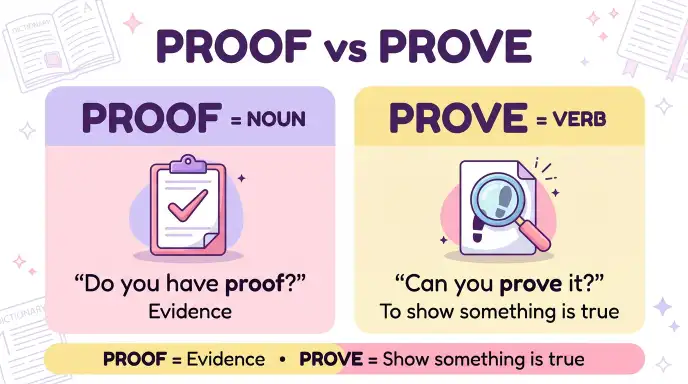
“Proof” is a noun meaning evidence that something is true, while “prove” is a verb meaning to show that something is true.
For example, you can say “I have proof” (noun), but “I can prove it” (verb). The two words are closely related, which is why they are so easy to mix up.
Many people use “proof” when they need “prove,” writing sentences like “I can proof it” by mistake. This small error can make your writing look careless, especially in professional or academic work.
The confusion grows because “proof” also appears in other forms, such as “proofread” and “waterproof.” Each of these uses has its own meaning and its own rules.
In this article, we explain the difference between proof and prove with simple examples. By the end, you will know exactly which word to use in every sentence.
Proof or Prove :Quick Answer
What Is the Difference Between Proof and Prove?
Proof is usually a noun. It means evidence or information that shows something is true. Prove is a verb. It means to show that something is true through facts, evidence, or clear reasoning.
Here is a simple way to remember the difference:
- Proof: The evidence that supports a claim.
- Prove: The act of showing that a claim is true.
Consider these examples:
- I need proof of your payment.
- Please prove that you made the payment.
- The report provides proof of the error.
- The report helps prove that the error occurred.
Both words relate to truth and evidence. However, proof names the evidence, while prove describes an action.
Proof vs Prove at a Glance
| Feature | Proof | Prove |
| Part of speech | Usually a noun | Verb |
| Main meaning | Evidence that supports a claim | To show that something is true |
| Example | We need proof. | We must prove it. |
| Common phrase | Proof of identity | Prove your identity |
| Related form | Proofs | Proves, proved, proving |
The easiest rule is to look at the action in your sentence. If you need a word for evidence, use proof. If you need a word for showing or demonstrating something, use prove.
A Simple Memory Trick
Think of proof as the thing you have and prove as the thing you do.
For example, you may have proof that a package was delivered. You can use that proof to prove that the delivery took place.
This simple trick can help you choose the correct word without memorizing many grammar rules.
The Origin of Proof and Prove:
Where Does the Word Proof Come From?
The word proof has a long history in English. It came through Old French, from a form of the word proeve, and is linked to the Latin word probare. The Latin word means to test, examine, or show something to be good or true.
Over time, proof developed several related meanings. It came to describe a test, a trial, or evidence used to support a statement. Today, people use the word in law, science, mathematics, education, and daily conversation.
For example:
- The lawyer presented proof in court.
- The student showed proof of completing the task.
- The scientist looked for proof to support the theory.
In each example, proof refers to evidence or a result that supports a claim.
Where Does the Word Prove Come From?
The word prove also comes through French and is connected to the Latin probare. It developed as a verb that means to test, establish, or demonstrate the truth of something.
Today, prove is common whenever someone needs to support a statement with evidence or reasoning.
For example:
- Can you prove your answer?
- The test may prove if the method works.
- She worked hard to prove her point.
In these sentences, prove describes an action. Someone is trying to establish that something is true.
Why Are Proof and Prove So Similar?
Proof and prove share a historical connection. Their meanings are closely related because both deal with testing, evidence, and truth.
However, English often uses different word forms for different grammatical jobs. A noun names a person, place, thing, or idea. A verb describes an action or state.
Compare these examples:
- Noun: The proof was clear.
- Verb: The results prove the claim.
The words have similar meanings, but they fit into different sentence structures.
Is Proof the Same as Evidence?
Proof and evidence are related, but they are not always interchangeable.
Evidence is information, a fact, or an item that supports a claim. Proof often refers to evidence or reasoning that establishes a conclusion. The exact difference depends on the situation.
For example, a photograph may be evidence that someone visited a place. Several reliable records may provide stronger proof of that visit.
In everyday English, people sometimes use the words in similar ways. However, in legal, scientific, and mathematical contexts, their meanings may be more specific.
British English vs American English Spelling:
Do British and American English Spell Proof and Prove Differently?
No. Both British English and American English use the same spellings for proof and prove.
Some English words have different spellings across these varieties. For example, British English uses colour, while American English uses color. However, proof and prove do not follow that pattern.
The correct spelling remains the same in the United States, the United Kingdom, Canada, Australia, and other English-speaking regions.
British English vs American English Comparison Table
| Word or phrase | British English | American English |
| Evidence | Proof | Proof |
| To demonstrate truth | Prove | Prove |
| Third-person verb | Proves | Proves |
| Past tense | Proved | Proved |
| Present participle | Proving | Proving |
As the table shows, there is no spelling difference between the two varieties.
What About the Word Proven?
The word proven is also used in both British and American English. It is a past participle of prove and can also function as an adjective.
For example:
- The method has been proven effective.
- She has proved her point.
- The results show a proven benefit.
Both proved and proven are accepted forms. Their use can depend on the sentence, the writing style, and regional preferences.
Does the Spelling Change in Formal Writing?
No. Formal writing does not change the spelling of proof or prove. Instead, the writer must choose the correct word based on its meaning and grammatical role.
For example, write:
- Please provide proof of your address.
- Please prove that the information is correct.
The first sentence asks for evidence. The second asks someone to demonstrate the truth of a statement.
Which Spelling Should You Use?
If You Are Writing for an American Audience
Use proof when you mean evidence and prove when you mean to demonstrate something.
For example:
- Please provide proof of purchase.
- We need to prove that the product works.
These forms are correct in American English and are also correct in other major varieties of English.
If You Are Writing for a British or Commonwealth Audience
The same rules apply in the United Kingdom, Australia, New Zealand, Canada, and other Commonwealth settings.
For example:
- The customer provided proof of payment.
- The results prove that the system is safe.
You do not need to change either word to match British spelling.
If You Are Writing for a Global Audience
For international readers, focus on simple sentences and clear meanings.
For example:
- Please send proof of your booking.
- Please prove that the details are correct.
These sentences are easy to understand across different English-speaking regions.
If you write for a website, keep your grammar and spelling consistent. You can follow British or American English for words that have regional spelling differences, but proof and prove stay the same.
Which Word Is Best for Professional Documents?
Both words are suitable for professional writing. The correct choice depends on what you want to say.
| Writing purpose | Correct word | Example |
| Requesting a receipt or record | Proof | Please send proof of payment. |
| Asking someone to support a claim | Prove | Please prove that the figures are correct. |
| Describing evidence in a report | Proof | The report contains proof of the issue. |
| Describing a result or action | Prove | The experiment may prove the theory. |
Professional tip: Do not choose a word because it sounds more formal. Choose the word that matches the meaning and sentence structure.
Common Mistakes with Proof and Prove:
Mistake 1: Using Prove When You Mean Proof
Incorrect: Please send me prove of your address.
Correct: Please send me proof of your address.
Why? The sentence asks for evidence. Since proof is a noun, it is the correct choice.
Mistake 2: Using Proof When You Need a Verb
Incorrect: Can you proof that this statement is true?
Correct: Can you prove that this statement is true?
Why? The sentence asks someone to demonstrate the truth of a statement. That action requires the verb prove.
Note that proof can be a verb in certain specialized contexts, such as proofreading or preparing a document for printing. However, it does not normally replace prove when you mean to demonstrate that something is true.
Mistake 3: Confusing Prove, Proved, and Proven
These forms are related, but they serve different purposes.
- Prove: I will prove my point.
- Proves: The evidence proves the claim.
- Proved: She proved her answer was correct.
- Proven: The method has proven useful.
A common error is to use proven in every situation where proved is needed. Both forms are correct in suitable contexts, but the sentence structure matters.
Mistake 4: Writing Proof Of Without a Clear Meaning
The phrase proof of is common and correct. However, the words that follow should explain what the evidence relates to.
Unclear: Please send proof of.
Clear: Please send proof of your identity.
Clear: We need proof of payment before processing the order.
Always name the thing that needs to be confirmed.
Mistake 5: Thinking Proof and Prove Are Regional Spellings
Some writers believe that proof is British English and prove is American English. This is incorrect.
Both words exist in both varieties of English. The difference is grammatical, not regional.
Mistake 6: Using Proofs Instead of Proves
Incorrect: The evidence proofs that he is right.
Correct: The evidence proves that he is right.
Why? When the subject is singular and the sentence uses the present tense, the verb form is proves.
The noun proofs is also correct when referring to multiple pieces or types of proof, such as proofs in mathematics or preliminary printed copies.
Quick Correction Table
| Incorrect sentence | Correct sentence |
| Send me prove of payment. | Send me proof of payment. |
| Can you proof your claim? | Can you prove your claim? |
| The report proof the result. | The report proves the result. |
| I need a prove. | I need proof. |
| She prove her point yesterday. | She proved her point yesterday. |
Remember that the main question is if you need a noun or a verb. That check will prevent most mistakes.
Proof and Prove in Everyday Examples:
Examples in Emails
In emails, proof often refers to documents or records. Prove is useful when asking someone to demonstrate that a statement is correct.
Examples:
- Please attach proof of payment to your email.
- Can you prove that the order was sent on time?
- We have proof that the invoice was received.
- The attached records prove that the payment was made.
In professional communication, use clear wording. It helps the reader understand exactly what you need.
Examples in News Reports
News reports often use proof and prove when discussing claims, investigations, and research.
Examples:
- Investigators searched for proof of fraud.
- The available evidence may prove that the report was inaccurate.
- Officials said they had proof of the transaction.
- The new findings could prove important to future research.
News writers should be careful with these words. Evidence may support a claim without proving it beyond doubt. The strength of the conclusion depends on the quality of the evidence and the context.
Examples on Social Media
On social media, both words appear in everyday discussions and debates.
Examples:
- Do you have proof of what happened?
- You cannot prove that statement with this picture alone.
- This screenshot is proof that the message was sent.
- The video may help prove what happened.
People often use these words in arguments. Still, it is important to remember that a screenshot, image, or video may not tell the whole story. Check the source and context before treating something as proof.
Examples in School and Academic Writing
Students use proof when discussing evidence, mathematical reasoning, and research findings. They use prove when describing what an argument or experiment establishes.
Examples:
- The student provided proof for the answer.
- The equation helps prove the result.
- The study offers proof to support the conclusion.
- The researcher tried to prove the hypothesis.
In mathematics, a proof is a logical explanation that shows why a statement follows from accepted facts or rules. In science, researchers usually test hypotheses and gather evidence rather than claim that one experiment proves every possible case.
Examples in Formal and Legal Writing
In legal settings, proof can refer to evidence used to establish a fact. Prove describes the process of establishing that fact under the rules of a legal system.
Examples:
- The lawyer presented proof of ownership.
- The court must decide if the evidence proves the claim.
- The document serves as proof of identity.
- The witness tried to prove that the event occurred.
Legal standards differ by jurisdiction and type of case. Therefore, everyday meanings should not be treated as a complete explanation of legal proof.
Proof or Prove :Comparison Tables
Proof, Prove, Proved, and Proven
These four forms are closely related, but each has a different role.
| Word | Grammar or use | Example |
| Proof | Noun | We found proof of the error. |
| Prove | Base verb | I can prove my answer. |
| Proves | Present-tense verb | The evidence proves the point. |
| Proved | Past tense or past participle | They proved the claim was false. |
| Proven | Past participle or adjective | This is a proven method. |
The noun proof names the evidence. The other forms relate to the verb prove and describe an action, result, or established quality.
Proof vs Evidence vs Demonstration
These words have related meanings, but they are not always interchangeable.
| Word | Main meaning | Example |
| Proof | Evidence or reasoning that establishes a claim | The receipt is proof of payment. |
| Evidence | Information that supports or challenges a claim | The receipt is evidence of payment. |
| Demonstration | An act of showing how something works or why it is true | The test was a demonstration of the method. |
Use proof when you want to emphasize support for a claim. Use evidence for information that may help establish what happened. Use demonstration when someone shows a process, result, or idea.
Proof or Prove : Google Trends and Usage Data:
Which Word Is More Popular?
Proof and prove are both common English words, but they appear in different contexts. Their search popularity can change based on the questions people ask and the topics they study.
For example, someone looking for a document may search for proof of address or proof of payment. A student learning grammar may search for proof or prove. Someone studying mathematics may search for mathematical proof or how to prove an equation.
These search phrases have different purposes. Therefore, a single comparison of the two words may not explain their overall use.
How Does Usage Vary by Country?
The spellings of proof and prove do not change between British and American English. Their use also extends across countries where English is widely spoken.
| Region | Common contexts | Spelling |
| United States | School, business, legal documents | Proof / Prove |
| United Kingdom | Education, research, professional writing | Proof / Prove |
| Canada | Business, education, daily communication | Proof / Prove |
| Australia | Work, study, personal communication | Proof / Prove |
| International English | Websites, emails, global business | Proof / Prove |
The table shows that the spelling remains the same. Differences in popularity may relate more to the subject and search phrase than to regional spelling.
How Can You Check Google Trends?
Google Trends is a useful tool for comparing search interest over time and across locations.
To compare the terms:
- Open Google Trends.
- Enter proof as the first search term.
- Add prove as the second search term.
- Select the country or region you want to study.
- Choose a time range, such as the past 12 months or five years.
- Review the interest-over-time graph and related queries.
Keep in mind that Google Trends shows relative search interest, not the exact number of searches. Its results can change with the selected region, time range, and search category.
Without checking a specific live Trends report, it would be misleading to claim that one word has a particular search advantage in a certain country. For grammar content, the most useful approach is to answer the user’s actual question and explain the difference with clear examples.
FAQs:
1. Is It Proof or Prove?
Both words are correct, but they have different uses. Proof is usually a noun meaning evidence, while prove is a verb meaning to show that something is true.
Example: “I need proof” and “I can prove it.”
2. What Is the Difference Between Proof and Prove?
Proof names evidence or reasoning that supports a claim. Prove describes the action of establishing that a claim is true.
Example: “The receipt is proof of payment” and “The receipt helps prove that payment was made.”
3. Is Proof a Noun or a Verb?
Proof is most commonly used as a noun. For example, “We need proof of identity.”
It can also be used as a verb in specialized contexts, such as proofing a document or checking a printed copy. However, when you mean to establish that something is true, the usual verb is prove.
4. Is Prove the Past Tense of Proof?
No. Prove is a verb, and its past tense is proved. Proof is usually a noun.
Example: “She proved her point” is correct. “She proof her point” is incorrect in standard English.
5. Is It Proved or Proven?
Both forms are correct. Proved is the simple past tense and can also be a past participle. Proven is also used as a past participle and as an adjective.
Examples:
- She proved her point yesterday.
- The method has been proven effective.
6. Do British and American English Use Different Spellings?
No. Both British and American English use proof and prove with the same spellings. The difference between these words comes from grammar and meaning, not regional spelling rules.
7. How Do I Remember When to Use Proof or Prove?
Remember this simple rule: proof is something you have, while prove is something you do.
For example, you can have proof of a claim and use it to prove that the claim is true. Check if your sentence needs a noun or a verb before choosing the word.
Conclusion: Proof or Prove : Which One Is Correct?
Choosing between proof and prove is simple once you understand their different roles. Proof is usually a noun that means evidence or information that supports a claim. Prove is a verb that means to show that something is true through facts, evidence, or reasoning.
For example, you can ask someone to provide proof of payment. You can also ask that person to prove that the payment was made. Both sentences are correct because each word serves a different purpose.
Remember that proof and prove are spelled the same way in British and American English. You do not need to choose one spelling for the United States and another for the United Kingdom. Instead, focus on the meaning of your sentence.
When writing emails, school assignments, reports, or website content, check if you need a noun or a verb. Also, remember the related forms proves, proved, and proven, as each has its own place in a sentence.
The easiest rule is to remember that proof is the evidence, and prove is the action. Keep this difference in mind, and you will be able to use both words correctly in everyday and formal English.
Must read!