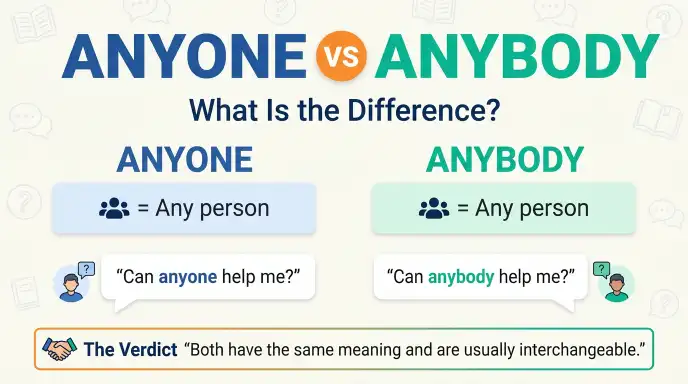
“Anyone” and “anybody” are indefinite pronouns that refer to any person, without pointing to a specific individual. For example, “Anyone can learn English” and “Anybody can learn English” carry the same meaning.
The main difference is in tone and style. “Anyone” sounds a little more formal and is common in writing, while “anybody” feels more casual and natural in everyday speech.
Many learners get confused because both words look so similar, and they worry about using the wrong one. The good news is that you will not make a grammar mistake with either choice.
In this article, we will look at how each word is used, where they differ slightly, and when to pick one over the other. By the end, you will know how to use “anyone” and “anybody” with confidence.
Anyone or Anybody : Quick Answer
The words anyone and anybody are both correct. They mean “any person” and can usually replace each other without changing the meaning of a sentence.
Use anyone if you prefer a slightly more formal tone. Use anybody if you want a friendly, conversational tone. However, this is a general style preference, not a strict grammar rule.
Here are some simple examples:
- Anyone: Does anyone know the answer?
- Anybody: Does anybody know the answer?
- Anyone: I did not see anyone outside.
- Anybody: I did not see anybody outside.
All four sentences are grammatically correct.
What Is the Main Difference?
The main difference is in style, not meaning. Both words refer to people without naming a particular person.
| Feature | Anyone | Anybody |
| Meaning | Any person | Any person |
| Grammar | Singular | Singular |
| Formal writing | Often preferred | Also correct |
| Everyday speech | Very common | Very common |
| Negative sentences | Correct | Correct |
| Questions | Correct | Correct |
Remember that both words take a singular verb when they are the subject of a sentence.
For example, “Anyone is welcome” is correct. The same rule applies to “Anybody is welcome.”
The Origin of Anyone or Anybody:
The words anyone and anybody developed from common English words that describe people in a general way. Both combine the word any with a word that refers to a person.
The word any has roots in Old English. It has long been used to express ideas such as “one of several,” “no matter which,” or “no matter who.”
How Did the Word Anyone Develop?
The word anyone combines any and one. Here, one means a person rather than the number one.
Over time, English speakers began using this combination to refer to an unknown or unspecified person. Today, it is common in questions, statements, and negative sentences.
For example:
- Anyone can learn a new skill.
- Has anyone called me?
- I do not know anyone here.
How Did the Word Anybody Develop?
The word anybody combines any and body. In this word, body refers to a person, not simply a physical body.
English speakers have used anybody for centuries. It became a natural way to refer to any person without naming someone specific.
For example:
- Anybody can join the game.
- Is anybody waiting outside?
- I could not find anybody to help me.
Why Are There Two Different Words?
English often has more than one word for the same idea. This happens because people develop different expressions over time, and both forms remain useful.
In this case, anyone and anybody became established parts of English. Neither spelling is a mistake, and neither is limited to a single country.
Unlike some spelling differences between British and American English, this pair does not follow a rule that makes one form British and the other American.
British English vs American English Spelling:
Both anyone and anybody are standard in British and American English. There is no spelling change between these varieties of English for this pair.
The main difference is how individual writers and speakers choose to use the words. Some may prefer anyone in formal documents, while others use anybody in conversation and informal writing.
Are Anyone and Anybody Different in the UK and US?
No. Both forms are accepted in the United Kingdom and the United States.
You can use either word in a British email, an American school assignment, or an international business report. Your choice should depend on the sentence and your preferred tone.
| Writing situation | British English | American English |
| Formal email | Anyone or anybody | Anyone or anybody |
| Casual conversation | Anyone or anybody | Anyone or anybody |
| Academic writing | Anyone is common | Anyone is common |
| Questions | Both are correct | Both are correct |
| Negative statements | Both are correct | Both are correct |
Does Commonwealth English Follow a Different Rule?
No special spelling rule separates anyone from anybody in Commonwealth English. Both words are used in countries such as Canada, Australia, and New Zealand.
Local writing habits may vary, but neither word is incorrect because of regional spelling.
For example, an Australian writer may say, “Has anybody seen my keys?” An American writer may say, “Has anyone seen my keys?” Both sentences are correct.
The important point is simple: do not treat anyone as the British spelling and anybody as the American spelling. That distinction is incorrect.
Which Spelling Should You Use?
Choosing between anyone and anybody is easy once you consider your audience and purpose. Since both words are correct, you do not need to worry about making a grammar mistake when you choose either one.
For American Readers
If you write for an American audience, you can use both words. In professional reports, essays, and formal messages, anyone may feel like the safer stylistic choice.
For example:
“Anyone interested in the position should submit an application.”
This sentence sounds clear and professional. Still, anybody interested in the position is also grammatically correct.
For British and Commonwealth Readers
British, Canadian, Australian, and New Zealand readers understand both forms. You can choose the word that fits your sentence best.
For formal writing, anyone is a good choice. For casual conversations, anybody sounds just as natural.
For Global English
If your readers come from different countries, focus on clarity. Both words are widely understood, so either one works well.
Use these simple tips:
- Choose anyone when you want a slightly formal style.
- Choose anybody when it fits the natural flow of your sentence.
- Use the same style throughout a document when possible.
- Never change a correct sentence just because you think one word belongs to a specific country.
Professional tip: Clear meaning matters more than choosing between these two words. Your sentence should sound natural and match the purpose of your writing.
Common Mistakes with Anyone or Anybody:
Although both words are easy to understand, some writers make mistakes when using them. The most common problems involve verb agreement, double negatives, and confusing these words with similar expressions.
Mistake 1: Using a Plural Verb
Anyone and anybody are grammatically singular. Therefore, they usually take singular verbs when they are the subject.
Incorrect: Anyone are welcome to join.
Correct: Anyone is welcome to join.
Incorrect: Anybody have the answer?
Correct: Does anybody have the answer?
In the second correction, does is used to form the question correctly.
Mistake 2: Thinking One Word Is Incorrect
Some people believe that anybody is too informal for all written English. Others think anyone sounds unnatural in conversation.
Neither belief is a grammar rule. Both words can appear in formal and informal writing.
For example, “Anybody can make a mistake” is correct. So is “Anyone can make a mistake.”
Mistake 3: Using Double Negatives
In standard English, avoid adding another negative when the sentence already contains a negative word such as nobody.
Incorrect: I did not see nobody.
Correct: I did not see anybody.
You can also write, “I saw nobody.” Both corrected sentences express a negative meaning, but the grammar differs.
Mistake 4: Confusing Anyone with Everyone
These words do not mean the same thing.
- Anyone: Any person, without naming a particular person.
- Everyone: All people in a group.
For example, “Anyone can enter” means that any person is allowed to enter. “Everyone must enter” means that all people in the relevant group must enter.
Mistake 5: Forgetting the Apostrophe Rule
Neither anyone nor anybody needs an apostrophe when used as an ordinary pronoun.
Incorrect: Anyones can apply.
Correct: Anyone can apply.
If you want to refer to something belonging to a person, you may need a different construction, such as “anyone’s bag.” Here, the apostrophe shows possession.
Anyone or Anybody in Everyday Examples:
Both words appear in daily conversations, emails, online posts, and professional documents. The best choice depends on the tone and meaning of your sentence.
In Everyday Conversation
People often use either word when asking questions or talking about an unknown person.
Examples:
- Does anyone want some tea?
- Can anybody help me with this box?
- Has anyone seen my phone?
- Is anybody coming to the party?
These sentences sound natural in everyday English.
In Emails and Messages
For work emails, anyone may sound slightly more polished. However, anybody is also acceptable when the message has a friendly tone.
Examples:
- “Can anyone share the updated file?”
- “Does anybody have a few minutes to discuss this?”
- “If anyone has questions, please contact me.”
- “Let me know if anybody needs help.”
For a formal message, the first and third examples are useful choices. Still, the other examples are not incorrect.
In News and Reports
Writers often use anyone when discussing rules, public services, or general situations.
Examples:
- Anyone with information should contact the police.
- Anyone can access the public report.
- The service is open to anyone who meets the requirements.
This word works well because it is direct and easy to understand.
On Social Media
Both words fit naturally in posts, comments, and captions.
Examples:
- “Anybody else tired today?”
- “Can anyone recommend a good book?”
- “Does anybody remember this old song?”
- “Anyone up for a movie night?”
The choice is personal. Do not assume that one word will make your post more popular or improve its reach.
In Academic and Formal Writing
Both words are grammatically acceptable, but anyone is often a good choice for clear, professional writing.
For example:
“Anyone who completes the course will receive a certificate.”
This sentence is direct and easy to read. You can use the same pattern in reports, instructions, essays, and workplace documents.
Anyone or Anybody : Comparison Table
The following table shows how both words work in different sentence types.
| Sentence type | Anyone example | Anybody example |
| Question | Does anyone know? | Does anybody know? |
| Negative | I did not tell anyone. | I did not tell anybody. |
| Positive | Anyone can try. | Anybody can try. |
| Formal notice | Anyone may apply. | Anybody may apply. |
| Casual conversation | Anyone coming? | Anybody coming? |
The final two examples in casual speech are shortened forms. They are common in conversation but may be less suitable for formal writing.
Related Words: Anyone, Anybody, Someone, and Somebody
These four words refer to people, but they do not always express the same idea.
| Word | Basic meaning | Example |
| Anyone | Any person | Can anyone help? |
| Anybody | Any person | Can anybody help? |
| Someone | An unspecified person | Someone called you. |
| Somebody | An unspecified person | Somebody left a bag. |
Use anyone or anybody when the sentence asks about any possible person or refers to people generally. Use someone or somebody when you mean that an unspecified person exists or did something.
For example, “Someone is at the door” suggests that a person is there. “Is anyone at the door?” asks if a person is there.
Anyone or Anybody : Google Trends and Usage Data:
People may search for “anyone or anybody” because they want to check grammar, improve their writing, or decide which word sounds more natural. Students, English learners, bloggers, and professional writers may all have this question.
However, there is an important difference between search popularity and correct usage. A word can receive more searches without being more grammatically correct.
Which Word Is More Popular?
Both words are common in modern English. Their popularity can vary according to the type of writing, the audience, and the context.
For instance, anyone is often a practical choice in formal documents. Meanwhile, anybody appears frequently in everyday questions and conversational expressions. These are general usage tendencies, not strict rules.
Without checking a live Google Trends comparison, it would not be accurate to claim that one word currently receives more searches or is more popular in a particular country.
How Can You Check Google Trends?
You can compare the two phrases using Google Trends.
- Open google trends.
- Enter “anyone” as your first search term.
- Add “anybody” as the second term.
- Select the country you want to study.
- Choose a time range, such as the past 12 months.
- Review the interest-over-time graph and regional results.
Keep in mind that Google Trends uses a normalized scale from 0 to 100. Its figures represent relative search interest, not the exact number of searches.
Does Search Popularity Affect Your Writing?
No. Search popularity does not determine which word is grammatically correct.
For website content, choose the word that best answers the reader’s question. If your article targets the phrase “anyone or anybody,” explain both terms naturally and include useful examples. Avoid repeating the keyword too often just to improve .
Helpful content, clear headings, correct grammar, and direct answers are better priorities than unsupported claims about search volume.
FAQs:
1. Is Anyone or Anybody Correct?
Both are correct. They mean “any person” and can usually replace each other without changing the sentence’s basic meaning.
2. Is Anyone More Formal Than Anybody?
Anyone can sound slightly more formal to some readers. However, both words are accepted in formal and informal English. The difference is a matter of style, not a strict rule.
3. Is Anybody One Word or Two?
Anybody is one word. You should not write it as “any body” when you mean “any person.”
The phrase any body can have a different meaning when body refers to a physical body or another kind of body.
4. Should I Use Anyone or Anybody in an Email?
Both work in emails. Choose anyone if you want a slightly more formal tone. Use anybody if it sounds more natural for your message and audience.
5. Do Anyone and Anybody Take Singular Verbs?
Yes. Both are singular pronouns.
Correct: Anyone is welcome.
Correct: Anybody knows the answer.
However, questions need the correct helping verb: “Does anybody know the answer?”
6. Are Anyone and Anybody Different in British and American English?
No. Both words are used in British and American English. Neither word belongs exclusively to one country.
7. Can Anyone and Anybody Be Used in Negative Sentences?
Yes. For example, “I did not see anyone” and “I did not see anybody” are both correct.
These sentences mean that you did not see a person. Avoid using an extra negative in standard English, such as “I did not see nobody.”
Conclusion:
When choosing anyone or anybody, remember that both words are correct and have almost the same meaning. Each refers to any person, so you can use either word in questions, negative sentences, everyday conversations, and many types of written English.
The main difference is style. Anyone may sound a little more formal to some readers, which makes it a useful choice for reports, academic work, and professional emails. On the other hand, anybody often feels natural in friendly conversations and casual messages. However, these are preferences rather than strict grammar rules.
Both words follow the same basic grammar pattern. They are singular pronouns, so they generally take singular verbs. You should also avoid confusing them with everyone, which refers to all people in a group, or with someone, which refers to an unspecified person.
For British, American, Commonwealth, and global English, either word is acceptable. Choose the one that makes your sentence clear and sounds natural for your audience. Most importantly, focus on correct grammar, simple wording, and clear communication. Once you understand these points, deciding between anyone and anybody becomes easy.
Kye insights!