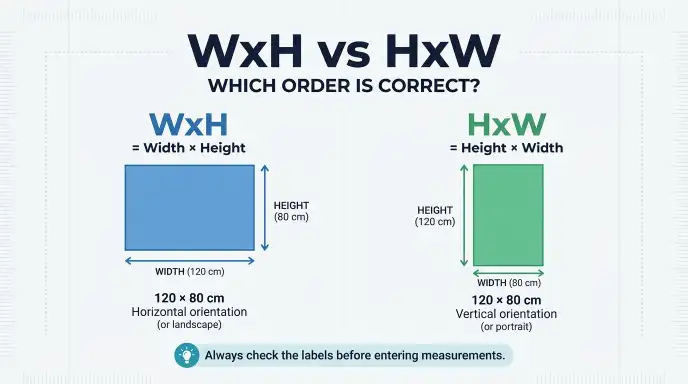
HxW is used in only a few cases, mainly in programming and data science, where image arrays are stored as height first, then width. In everyday design, photography, and screen sizes, you will almost always see WxH.
This order is confusing because different fields follow different rules. Printers, web designers, and video editors use width x height, while libraries like NumPy and PyTorch use height x width for image shapes.
Mixing up the two can flip your image, stretch your design, or break your code. That is why it is important to know which format a tool or platform expects before you enter any dimensions.
In this article, we will explain when to use WxH and when HxW applies, with simple examples. By the end, you will always know the right order for your project.
WxH or HxW : Quick Answer
What Do WxH and HxW Mean?
WxH and HxW describe the order of two measurements: width and height.
- WxH: Width × Height
- HxW: Height × Width
Width usually measures how far something extends from side to side. Height measures how tall something is from bottom to top.
For example, if a picture is 120 cm wide and 80 cm tall, its dimensions in WxH format are 120 × 80 cm. In HxW format, the same dimensions are written as 80 × 120 cm.
The measurements describe the same width and height, but their order changes.
| Format | First measurement | Second measurement | Example |
| WxH | Width | Height | 120 × 80 cm |
| HxW | Height | Width | 80 × 120 cm |
| W × H | Width | Height | 120 × 80 cm |
| H × W | Height | Width | 80 × 120 cm |
Which one is correct?
Neither format is always correct in every situation. WxH is a common way to list dimensions in design, printing, and product descriptions. HxW may be used when a system or person lists height first.
Always check the labels or instructions before entering measurements.
The Origin of WxH or HxW:
Why Do These Formats Exist?
WxH and HxW come from the need to describe the size of objects in a clear and short way. Instead of writing “width by height” every time, people use the letters W and H.
W stands for width, and H stands for height. The letter x or the multiplication symbol × separates the two measurements. It is usually read as “by” rather than as a multiplication problem.
For example, 120 × 80 cm is often read as “120 centimetres by 80 centimetres.”
These formats are useful because people work with dimensions in many fields. A printer needs to know the size of a page. A photographer needs to know an image’s dimensions. A furniture seller needs to describe the size of a table.
The order may differ because different tools, businesses, and industries use different conventions.
Why Does the Order Matter?
The order matters because width and height describe different directions.
Imagine a rectangular picture. It is 120 cm wide and 80 cm tall. If you enter 80 as the width and 120 as the height, the result may be a taller design instead of a wider one.
The same issue can occur when you order a frame, create a banner, or upload an image.
However, switching the order does not always change the total area of a rectangle. A rectangle measuring 120 × 80 cm has the same area as one measuring 80 × 120 cm. The difference is its orientation and the way the measurements are assigned.
British English vs American English Spelling:
Is There a Difference Between UK and US Usage?
WxH and HxW are measurement formats, not different spellings of an English word. Therefore, British English and American English do not have separate spelling rules for these abbreviations.
Both countries use width and height to describe dimensions. The order may depend on the product, software, company, or technical instructions.
For example, a British printer and an American printer may both ask for the width and height of an image. One form may request width first, while another may ask for height first.
It is better to follow the format shown on the form than to assume that one order belongs to a specific country.
| Feature | British English | American English |
| Width | Width | Width |
| Height | Height | Height |
| WxH meaning | Width × Height | Width × Height |
| HxW meaning | Height × Width | Height × Width |
| Measurement order | Depends on the context | Depends on the context |
What About Metric and Imperial Units?
The units can change between countries, but the meaning of W and H stays the same.
| Measurement | Metric example | Imperial example |
| Width | 120 cm | 48 inches |
| Height | 80 cm | 32 inches |
| WxH format | 120 × 80 cm | 48 × 32 inches |
| HxW format | 80 × 120 cm | 32 × 48 inches |
These examples show the order of the measurements. The values are illustrative, so always use the actual dimensions of your item.
Do not mix units without converting them first. For example, entering a width in centimetres and a height in inches may cause errors in a design or order.
Which Spelling Should You Use?
Choose the Format That Matches Your Purpose
When deciding between WxH and HxW, start by checking the instructions. The best format is the one expected by the tool, form, or person receiving the measurements.
For US audiences: Use the order specified by the website, supplier, or design application. Do not assume that all American products use one order.
For UK and Commonwealth audiences: The same advice applies. Follow the labels and keep the units consistent.
For international audiences: Write the full terms when there is a chance of confusion. For example, use “Width: 120 cm; Height: 80 cm” instead of writing only “120 × 80 cm.”
This is especially helpful when sending dimensions to someone who may not know your preferred format.
A Simple Rule to Remember
If the format says WxH, enter the width first and the height second. If it says HxW, enter the height first and the width second.
Never rely only on the size numbers. Check the labels before you use them.
Common Mistakes with WxH or HxW:
Errors You Should Avoid
People often make small mistakes when reading or entering dimensions. These errors can lead to incorrect orders or designs.
1. Assuming both formats have the same order
WxH and HxW use the same measurements in a different order. Always check which dimension comes first.
2. Confusing width with height
Width is usually the side-to-side measurement, while height is the bottom-to-top measurement. For unusual objects, check the product’s stated orientation.
3. Forgetting the units
A number without a unit may be unclear. Write 120 cm or 48 inches rather than writing 120 alone.
4. Mixing centimetres and inches
Use the same unit for both measurements unless the form specifically asks for different units.
5. Assuming the first number is always width
This is not always true. Some forms ask for height first, so read their labels carefully.
6. Ignoring the object’s orientation
A 120 × 80 cm rectangle is wider than it is tall when displayed in landscape orientation. Reversing the dimensions may produce a portrait layout.
7. Entering measurements in the wrong fields
If a form has separate boxes for width and height, enter each value in its labelled field. Do not simply copy the numbers in the order shown elsewhere.
WxH or HxW in Everyday Examples:
How Are These Formats Used?
Dimensions appear in many everyday tasks. The following examples show how to read them correctly.
1. Images and graphic design
Suppose you are making a banner that is 1200 pixels wide and 400 pixels tall.
- WxH: 1200 × 400 pixels
- HxW: 400 × 1200 pixels
If your design tool asks for width first, enter 1200 in the width field and 400 in the height field.
2. Picture frames
A picture measures 30 cm wide and 20 cm tall. Its WxH dimensions are 30 × 20 cm. If a seller lists height first, the same measurements may appear as 20 × 30 cm.
Check if the listing gives the frame’s outer size or the size of the picture it can hold.
3. Furniture
A table might be listed as 120 cm wide and 75 cm high. These measurements describe its width and height, but a full furniture description may also include depth. In that case, check if the seller uses width × depth × height or another order.
4. Emails and messages
When sending measurements to a client, avoid unclear abbreviations if the recipient may not know them.
For example, write: “The image is 1200 pixels wide and 400 pixels high.”
This message is easier to understand than a bare string of numbers.
5. News and product descriptions
Product listings may show dimensions in a short format to save space. Read the product specifications to confirm which measurement comes first.
6. Formal documents
In technical reports, quotations, and order forms, use the format required by the document. If no format is given, label each measurement clearly.
Example Comparison Table:
| Situation | Recommended approach | Example |
| Creating a banner | Follow the design tool’s fields | Width 1200 px, height 400 px |
| Ordering a frame | Check the seller’s dimension order | Width 30 cm, height 20 cm |
| Sending an email | Spell out the measurements | 30 cm wide, 20 cm high |
| Completing a form | Follow its labels | Enter width and height separately |
| Writing a technical report | State units and dimensions clearly | Width: 120 cm; Height: 80 cm |
FAQs:
1. What Does WxH Mean?
WxH means width multiplied by height in a dimension label. It usually describes width first and height second. For example, 120 × 80 cm means 120 cm wide and 80 cm tall when the format is WxH.
2. What Does HxW Mean?
HxW means height followed by width. For example, 80 × 120 cm means 80 cm tall and 120 cm wide when the format is HxW.
3. Is WxH the Same as HxW?
No, the order is different. However, both formats can describe the same two measurements when the values are rearranged correctly. Always check the labels to understand which number represents width and which represents height.
4. Which Comes First, Width or Height?
It depends on the format. In WxH, width comes first. In HxW, height comes first. If you are using a website, form, or design tool, follow its instructions.
5. Is WxH Used More Often Than HxW?
WxH is a familiar format in many design and product contexts, but usage varies by industry and software. There is no single order that applies to every product or application. Check the relevant specifications instead of relying on a general rule.
6. Does WxH Mean Landscape and HxW Mean Portrait?
Not by itself. The letters describe the order of the measurements. If width is greater than height, the rectangle is generally landscape. If height is greater than width, it is generally portrait. The format alone does not determine the orientation; the actual values do.
7. How Can I Avoid Confusion When Writing Dimensions?
Write the full labels and include the units. For example, “Width: 120 cm; Height: 80 cm” is clear even if the reader is unfamiliar with WxH or HxW. When using a form, enter each value in the correct field.
Conclusion:
Understanding WxH or HxW is simple once you know what the letters mean. WxH stands for width followed by height, while HxW stands for height followed by width. Both formats can describe the same object, but the numbers must be placed in the correct order.
The most important rule is to check the instructions before entering or sharing measurements. A design tool, product listing, or order form may use a different format, so never assume that the first number always represents width.
When you work with images, picture frames, furniture, or other objects, include the units and label each measurement when possible. This small step can prevent mistakes and make your instructions easier to follow.
If you are unsure which format to use, write the measurements in full, such as “120 cm wide and 80 cm tall.” Clear labels are more useful than relying on an abbreviation alone.
In short, choose WxH when the instructions request width first and HxW when they request height first. Follow the stated format, keep the units consistent, and check the object’s orientation before completing your work.
Continue reading!

I’m James Mitchell, a language and content writer focused on grammar, spelling, word usage, and everyday English. I enjoy making confusing words and common language questions simple and easy to understand.