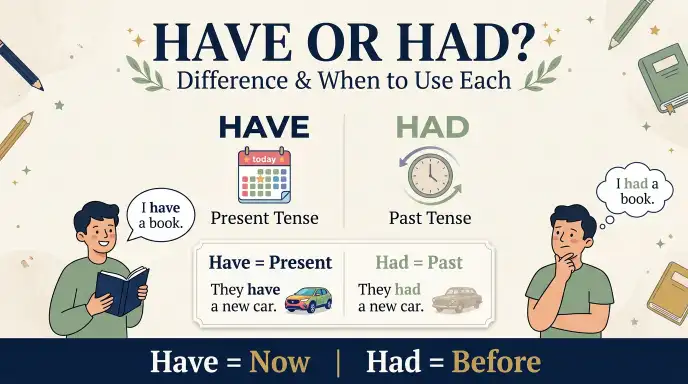
Use “have” for the present and “had” for the past, so say “I have a car” now and “I had a car” yesterday.
Choosing between “have or had” confuses many English learners, even those who speak the language every day. The difference looks small, but using the wrong word can change the meaning of your sentence completely.
“Have” talks about what you own, do, or experience right now. “Had” talks about something that already happened or finished in the past.
Both words also work as helping verbs, which is where most mistakes happen. For example, “I have finished” and “I had finished” describe two different moments in time.
In this guide, you will learn simple rules, clear examples, and easy tricks to use “have or had” correctly. By the end, you will never feel unsure about these two words again.
Defination:
“Have or had” refers to the two tenses of the verb “to have.” Use have to talk about the present (I have a phone) and had to talk about the past (I had a phone).
Have or Had : Quick Answer
The main difference between have and had is time.
- Have is the present form of the verb. It is used with I, you, we, and they, as well as plural subjects.
- Had is the past form of the verb. It can be used with all subjects when talking about the past.
For example:
- I have a new phone. (I own it now.)
- I had an old phone. (I owned it in the past.)
- They have two children. (This describes their present situation.)
- They had a small house. (This describes their past situation.)
The basic grammar rule
Use have for the present and had for the past. However, there is one more important rule: had is also used as a helping verb in the past perfect tense.
For example:
- I have finished my work. (Present perfect)
- I had finished my work before dinner. (Past perfect)
The first sentence connects a completed action to the present. The second sentence shows that one action was complete before another past event.
| Have | Had |
| Usually shows the present | Usually shows the past |
| I have a book. | I had a book. |
| We have enough time. | We had enough time. |
| They have arrived. | They had arrived earlier. |
Remember this simple tip: if you are talking about something that is true now, have may be the right choice. If you are talking about something that happened or was true in the past, had may be correct.
However, always check the full sentence because have and had can also work as helping verbs.
The Origin of Have or Had:
The words have and had are different forms of the same verb. They are not spelling variations of each other. Instead, they have different grammatical jobs.
Where does the word have come from?
The word have comes from Old English habban. It has roots in early Germanic languages and has been used for many centuries.
In older forms of English, the verb was used to describe ownership, possession, and relationships. Over time, it also became an important part of English grammar.
Today, have can describe ownership, experiences, needs, and actions.
Examples:
- I have a sister.
- We have lunch at noon.
- You have done a good job.
The first example shows a family relationship. The second describes a routine, while the third uses “have” to form the present perfect tense.
Where does the word had come from?
Had is the past form and past participle of have. It developed from older forms of the same verb.
English verbs do not all form their past tense in the same way. For example, walk becomes walked, but have becomes had. This is why have and had are known as forms of an irregular verb.
Compare these examples:
- I have a dog.
- I had a dog.
- I have had a dog for five years.
The last sentence uses both words. The first have is a helping verb, while had is the past participle. Together, they form the present perfect tense.
Why are have and had different?
The difference exists because English changes verbs to show time and grammar. Some verbs follow regular patterns, while others have special forms.
| Verb form | Word | Example |
| Base form | Have | I want to have a pet. |
| Present form | Have | I have a pet. |
| Third-person singular present | Has | She has a pet. |
| Simple past | Had | She had a pet. |
| Past participle | Had | She has had a pet. |
The important point is that have and had belong to the same verb. You choose between them based on the subject, tense, and meaning of the sentence.
British English vs American English Spelling:
British English and American English often use different spellings for the same word. For example, British English uses colour, while American English uses color.
However, have and had are spelled the same way in British and American English. The main difference is not spelling. It is how each word is used in a sentence.
Are have and had different in the UK and US?
No. Both British and American speakers use have and had according to the same basic grammar rules.
For example:
- British English: I have a new bicycle.
- American English: I have a new bicycle.
- British English: We had a meeting yesterday.
- American English: We had a meeting yesterday.
All four sentences are correct.
Comparison table: British English vs American English
| Grammar point | British English | American English |
| Present possession | I have a car. | I have a car. |
| Past possession | I had a car. | I had a car. |
| Present perfect | I have just eaten. | I have just eaten. |
| Past perfect | I had already eaten. | I had already eaten. |
| Spelling of have | Have | Have |
| Spelling of had | Had | Had |
Is there any difference in everyday speech?
There can be differences in style and frequency, especially when people use have got or have gotten.
For example:
- British English: I have got a new job.
- American English: I have a new job.
- American English: I have gotten better at English.
In British English, got is common in expressions such as “I have got a car.” In American English, gotten is often used as the past participle of get.
These differences do not change the basic rules for have and had.
Which Spelling Should You Use?
You do not need to choose between different spellings of have and had. Both forms are standard in British English, American English, and other major varieties of English.
Instead, choose the correct word based on the meaning and grammar of your sentence.
If your readers are in the United States
Use standard American English grammar. Write have for the present and had for the past when the sentence calls for those forms.
Examples:
- I have a question about the project.
- We had a problem yesterday.
- She has finished her homework.
If your readers are in the United Kingdom
Follow the same basic rules. British English uses have and had in the same way.
Examples:
- I have a meeting today.
- He had a busy day yesterday.
- They have completed the task.
If you write for a global audience
Use simple sentences and standard grammar. Readers from different countries will understand both words when they are used correctly.
For example:
- I have time to help you.
- I had time to help you yesterday.
The first sentence describes the present. The second describes the past.
For website articles, school assignments, business emails, and professional documents, consistency and correct grammar matter more than choosing a regional spelling.
Common Mistakes with Have or Had:
Many learners make mistakes with have and had because they focus only on the meaning of a sentence. To choose correctly, you also need to look at the subject and tense.
Mistake 1: Using have instead of has
With he, she, and it, the simple present form is usually has, not have.
Incorrect: She have a new bag.
Correct: She has a new bag.
Remember that I, you, we, and they use have in the simple present. Third-person singular subjects use has.
Mistake 2: Using had for the present
Use had when the sentence refers to the past, not simply because it sounds natural.
Incorrect: I had a meeting every Monday, and I still do.
Better: I have a meeting every Monday.
The past form may be correct if the meetings happened in the past and no longer happen.
Mistake 3: Using have after did
After did or didn’t, use the base form of the main verb.
Incorrect: Did you had breakfast?
Correct: Did you have breakfast?
The word did already shows the past tense, so the main verb stays in its base form.
The same rule applies to negative sentences:
- Incorrect: I didn’t had time.
- Correct: I didn’t have time.
Mistake 4: Confusing have had with had had
Both expressions can be correct, but they have different meanings.
- I have had a headache all morning.
- I had had a headache before I took the medicine.
The first sentence connects the headache to the present. The second places the headache before another past event.
Mistake 5: Using had with will
After will, use the base form have, not had.
Incorrect: I will had enough time.
Correct: I will have enough time.
This rule also applies to other future expressions with will.
Mistake 6: Using have instead of had in a past event
Incorrect: We have a great time at the party yesterday.
Correct: We had a great time at the party yesterday.
The word yesterday clearly places the event in the past. Therefore, had is the correct form in this sentence.
Mistake 7: Forgetting the past participle pattern
When you use the present perfect tense, the structure is usually have/has + past participle.
Correct examples:
- I have had lunch.
- She has had enough rest.
- They have had several chances.
These sentences are correct because had is the past participle of have.
Have or Had in Everyday Examples:
The easiest way to understand the difference is to see how the words work in real situations.
In emails
Professional emails often use have to describe current situations and had to explain past events.
Examples:
- I have a question about the report.
- We had a meeting with the client yesterday.
- I have received your email.
- We had some delays last week.
Use the word that matches the time you want to describe. This helps your message sound clear and professional.
In news writing
News articles use both words to report current information and earlier events.
Examples:
- The company has announced a new plan.
- The team had faced several challenges before the final match.
- Officials have confirmed the new rules.
- The town had experienced heavy rain before the roads closed.
The present perfect often connects a past event to the current situation. The past perfect shows that one past event happened before another.
On social media
People use have and had in posts, comments, captions, and messages.
Examples:
- I have the best friends!
- We had so much fun yesterday.
- Have you seen this video?
- I had no idea about this!
In casual writing, people may shorten sentences or leave out words. However, the standard grammar rules remain the same.
In formal writing
In reports, essays, and academic work, the choice depends on the tense and the meaning.
Examples:
- The study has found a link between the two factors.
- The researchers had completed the first stage before collecting more data.
- The school has introduced a new policy.
- The school had used the old system for many years before the change.
Always make sure the tense fits the timeline of your writing.
Comparison table: Everyday use
| Situation | Correct sentence | Why it works |
| Present possession | I have a laptop. | It describes what I own now. |
| Past possession | I had a laptop. | It describes what I owned in the past. |
| Current result | I have completed the task. | The action is linked to the present. |
| Earlier past action | I had completed the task before noon. | The action happened before another past time. |
| Present question | Do you have a pen? | The question uses the base form after do. |
| Past question | Did you have a pen? | The question uses the base form after did. |
Have or Had: Understanding Tense and Usage Data:
When people search for “have or had,” they may want a quick grammar answer, help with a sentence, or a simple explanation of verb tenses.
These searches are useful because the words look different but belong to the same verb. The main question is often whether the sentence describes the present, the past, or an earlier past action.
What does Google Trends tell us?
Google Trends can help writers explore how interest in a search term changes over time and across regions. However, it does not provide an exact count of all searches.
Search interest is usually shown on a relative scale from 0 to 100. A value of 100 represents the highest interest for the selected term, place, and time range. It does not mean that 100 people searched for the term.
To compare interest in have or had, you should check the exact phrase in Google Trends and select a suitable period and region. You can also compare related searches, such as “have vs had,” “when to use had,” and “have and had difference.”
Which countries may be interested in this topic?
English grammar questions can attract readers from many countries, including the United States, the United Kingdom, Canada, Australia, India, and Pakistan.
However, this does not prove which country has the highest search interest for this exact keyword. You should use a live Google Trends comparison to confirm regional patterns before making that claim.
How can this information help your article?
Use search intent to guide your content. Readers who search for have or had usually need a clear answer, simple rules, and examples they can apply immediately.
For a helpful grammar article:
- Answer the main question near the start.
- Explain the difference between present and past forms.
- Include examples with different subjects.
- Explain common errors with did, has, and have had.
- Use tables to make the rules easy to compare.
- Add FAQs that address real grammar questions.
Google Trends can support keyword research, but it cannot guarantee a high ranking. Clear explanations, accurate examples, useful content, and a good reading experience are more important than repeating the keyword many times.
Have or Had: Comparison Table
The following table summarizes the main differences between the two words and shows how they work in common sentence patterns.
| Feature | Have | Had |
| Main use | Present form | Past form and past participle |
| Example of ownership | I have a bike. | I had a bike. |
| With I, you, we, they in simple present | I have time. | Not normally used for present meaning |
| With he, she, it in simple present | She has time. | She had time yesterday. |
| Present perfect | I have had lunch. | Used as the past participle |
| Past perfect | Not the main past participle | I had had lunch before leaving. |
| After did | Did you have time? | Do not use had after did in a standard question |
| After will | I will have time. | Do not use had after will |
| Regional spelling | Same in British and American English | Same in British and American English |
A simple way to remember the difference
Think about the timeline of your sentence.
- Now: I have a plan.
- Yesterday: I had a plan.
- Before another past event: I had made a plan before the meeting began.
- From the past until now: I have had this plan for months.
These examples show why you should look at the whole sentence rather than choosing a word based on a single clue.
FAQs:
Q1. When to use have and had?
Use “have” for the present and “had” for the past. Say “I have a car” when you own it now, and “I had a car” when you owned it before. Use “has” with he, she, and it.
Q2. When to use was and had?
Use “was” to describe a state or condition, and “had” to show possession or experience in the past. For example, “She was tired” describes how she felt, while “She had a headache” shows what she experienced.
Q3. Can I say “have you had”?
Yes, “have you had” is correct. It is the present perfect form, used to ask about an experience up to now. Examples: “Have you had lunch?” and “Have you had this problem before?”
Q4. Had used vs have used?
Use “have used” for an action connected to the present, and “had used” for an action completed before another past event. For example, “I have used this app for years” versus “I had used this app before it changed.”
Q5. Is “I’ve had” correct grammar?
Yes, “I’ve had” is correct. It is the short form of “I have had” and works in both speaking and writing. Example: “I’ve had a great day.”
Q6. Which is correct: “I ate” or “I have eaten”?
Both are correct, but they are used differently. Use “I ate” for a finished action at a specific past time (“I ate at 2 PM”). Use “I have eaten” when the result matters now (“I have eaten, so I’m not hungry”).
Conclusion:
Understanding have or had is easier when you focus on the time and meaning of a sentence. Both words come from the same verb, but they do different jobs. Have is used in the present with subjects such as I, you, we, and they. With he, she, or it, the present form is usually has. On the other hand, had is the simple past form and the past participle of have.
For example, “I have a new phone” describes the present, while “I had a new phone” describes a past situation. You can also use both forms together, as in “I have had this phone for two years.” In that sentence, the present perfect connects the past to the present.
Remember to use the base form have after did and will. Also, do not confuse have had with had had, because each form has a different role in the sentence.
The spelling is the same in British and American English, so you do not need to worry about regional spelling rules. Instead, focus on grammar, timing, and meaning. With regular practice, you will learn to choose the correct form in conversations, emails, essays, and other types of writing.
Further Reading!

I’m James Mitchell, a language and content writer focused on grammar, spelling, word usage, and everyday English. I enjoy making confusing words and common language questions simple and easy to understand.