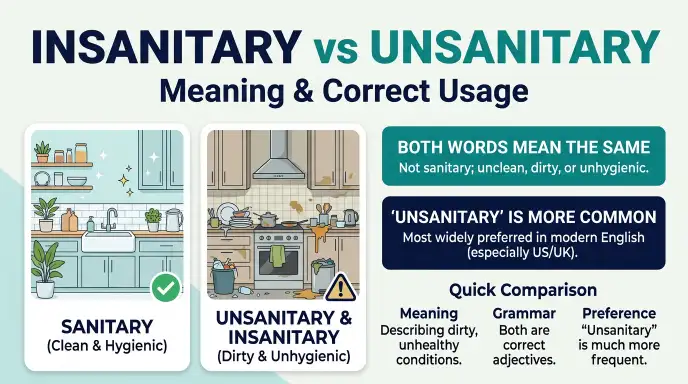
Insanitary and unsanitary both mean dirty and harmful to health, but “unsanitary” is far more common in American English, while “insanitary” is mostly used in British English.
Both words describe places or conditions that are not clean enough to protect people from disease. For example, you might use them for a dirty kitchen, a polluted water supply, or a crowded public toilet.
The difference comes from the prefixes. “In-” and “un-” both mean “not,” and English speakers have used both forms with “sanitary” for over a century. Today, “unsanitary” is the more popular choice in everyday writing, news, and health reports.
“Insanitary” still appears in British dictionaries, older books, and formal documents, especially in legal and government texts in the UK. Many readers may find it old-fashioned, but it is still correct.
In this article, we will explore the difference between insanitary and unsanitary, where each word is used, and which one is best for your writing. Whether you are a student, a blogger, or a professional, this guide will give you a clear and simple answer.
Defination!
Unsanitary means dirty and harmful to health. It is the more common word, especially in American English.Insanitary has the same meaning, but it is mostly used in British English and in formal or older writing.
Insanitary or Unsanitary : Quick Answer
Which Word Is Correct?
Both insanitary and unsanitary are correct English words. They describe conditions that are not clean, hygienic, or safe for health.
However, unsanitary is usually the better choice for everyday writing because it is more widely used and easily understood.
Here are some examples:
- The kitchen was unsanitary.
- The workers reported insanitary conditions in the building.
- Unsanitary water can spread disease.
- The inspector found insanitary conditions in the old house.
All four sentences are grammatically correct. The main difference is usage, not meaning.
Quick Comparison Table
| Feature | Insanitary | Unsanitary |
| Correct spelling | Yes | Yes |
| Main meaning | Not clean or hygienic | Not clean or hygienic |
| Common usage | Less common | More common |
| Everyday writing | Correct, but less usual | Recommended |
| Formal reports | Acceptable | Acceptable |
| American English | Used, but less common | Widely used |
If you are unsure which word to choose, use unsanitary. It is a clear and natural option for most readers.
The Origin of Insanitary or Unsanitary:
Where Does the Word Insanitary Come From?
The word insanitary is formed from the prefix in- and the word sanitary. The prefix in- can mean “not” or “opposite of.” Therefore, insanitary means not sanitary.
The word sanitary is linked to health and cleanliness. It comes through French from Latin roots associated with health and being healthy.
Over time, English speakers used insanitary to describe places or conditions that lacked proper cleanliness. The word can appear in older writing, public health discussions, and formal descriptions of poor living conditions.
For example:
- The report described insanitary housing.
- The workers lived in insanitary conditions.
- The old building had insanitary toilets.
These sentences describe places where cleanliness and hygiene are poor.
Where Does the Word Unsanitary Come From?
The word unsanitary uses the prefix un-, which also means “not.” When un- joins sanitary, it creates a word that means not sanitary or not hygienic.
English uses the prefix un- in many common words:
- Clean → Unclean
- Safe → Unsafe
- Healthy → Unhealthy
- Sanitary → Unsanitary
This pattern makes unsanitary easy to understand. It is widely used in modern English, especially when people discuss hygiene, food safety, water quality, and public health.
For example:
- The restaurant had unsanitary kitchen equipment.
- The town worked to improve unsanitary living conditions.
- The food was stored in an unsanitary place.
Why Are There Two Words With the Same Meaning?
English has many words that share similar meanings because the language developed over hundreds of years. Different prefixes can sometimes create words with almost the same meaning.
In this case, in- and un- both help express a negative meaning. That is why insanitary and unsanitary can describe the same type of condition.
The difference is mainly in common usage and style. Neither word is automatically wrong, but unsanitary is more familiar to many modern readers.
British English vs American English Spelling:
Do British and American English Use Different Spellings?
British and American English use the same spelling for insanitary and unsanitary. Neither word needs a spelling change when you write for a British or American audience.
The difference is more about word choice and how common each word is. Unsanitary is widely recognized in both varieties, while insanitary may sound more formal or less familiar.
For example:
- British English: The building had unsanitary conditions.
- American English: The building had unsanitary conditions.
- British English: The report described insanitary housing.
- American English: The report described insanitary housing.
All these examples are correct. The best choice depends on the style of your writing and the audience you want to reach.
British English vs American English Comparison Table
| Point | British English | American English |
| Preferred everyday choice | Unsanitary | Unsanitary |
| Alternative word | Insanitary | Insanitary |
| Spelling of unsanitary | Same | Same |
| Spelling of insanitary | Same | Same |
| Meaning of both words | Not hygienic | Not hygienic |
Which Word Sounds More Natural?
In most everyday situations, unsanitary sounds natural and clear. You can use it in schoolwork, emails, news writing, and general reports.
Insanitary is also correct, but some readers may find it less familiar. If you are writing for a broad audience, choosing the more common word can help your message feel simple and direct.
For example, “The restaurant was unsanitary” is a clear way to describe a restaurant with poor hygiene.
Which Spelling Should You Use?
Advice for American English Writers
If you write for readers in the United States, use unsanitary in most cases. It is a familiar word for describing places, objects, or conditions that are not clean or hygienic.
Examples include:
- The inspector found unsanitary conditions.
- The restaurant must fix its unsanitary kitchen.
- The water was unsafe because of unsanitary storage.
You can still use insanitary when it fits the source or style of your writing. However, it is usually not necessary when a simpler, more common word is available.
Advice for British English and Commonwealth Writers
British English speakers can also use unsanitary. It is clear and widely understood.
You may encounter insanitary in formal reports, historical texts, or official descriptions. If you are quoting a document, keep the original word. If you are writing a new article, unsanitary is a practical choice for general readers.
For example:
- The report found unsanitary conditions in the building.
- The old record described insanitary housing.
Both sentences work, but the first is a straightforward choice for modern writing.
Advice for Global English Writers
If your readers come from many countries, choose the word that is easiest to understand. In most cases, unsanitary is the safer option.
You can also use simple phrases such as “poor hygiene,” “not clean,” or “unsafe for health” when you want to avoid less familiar vocabulary.
For example:
- The kitchen was unsanitary.
- The kitchen had poor hygiene.
- The kitchen was not clean enough for safe food preparation.
These options help readers understand your point without needing to know the difference between the two words.
Common Mistakes With Insanitary or Unsanitary:
Mistake 1: Thinking Insanitary Is Always Wrong
Some people believe that insanitary is a spelling mistake. This is not true. It is a valid English word.
Incorrect claim: “Insanitary is not a real word.”
Correct explanation: “Insanitary is correct, but unsanitary is more common.”
If you see insanitary in a book or report, do not assume it is an error.
Mistake 2: Thinking the Words Have Different Meanings
The words have almost the same meaning. Both describe conditions that are not sanitary.
For example:
- The room was insanitary.
- The room was unsanitary.
Both sentences suggest that the room was not clean or hygienic. The choice does not usually change the main meaning.
Mistake 3: Using Unsanitary for Every Kind of Dirt
The word unsanitary is especially useful when poor cleanliness may affect health. It is not always the best word for every dirty object.
For example:
- Better: The kitchen was unsanitary because food waste attracted pests.
- More direct: My shoes were muddy.
Muddy shoes are dirty, but they are not necessarily unsanitary. Choose the word that best fits the situation.
Mistake 4: Confusing Unsanitary With Unhealthy
These words are related, but they are not exactly the same.
- Unsanitary describes poor cleanliness or hygiene.
- Unhealthy describes something that may harm health or well-being.
For example, dirty drinking water may be unsanitary and unhealthy. A lack of exercise may be unhealthy, but it is not usually called unsanitary.
Mistake 5: Using the Word Without Clear Evidence
In reports about food, buildings, or workplaces, it is better to describe the actual problem instead of making a broad claim.
For example, “The kitchen had dirty surfaces and spoiled food” gives more detail than “The kitchen was unsanitary.”
Specific details help readers understand why a place may be unsafe.
Common Errors and Corrections Table
| Incorrect idea or weak wording | Better explanation or wording |
| Insanitary is always wrong. | Insanitary is a correct word. |
| Unsanitary means something different. | Both words have nearly the same meaning. |
| The spelling changes in the US. | Both spellings stay the same. |
| The shoes were unsanitary because they were muddy. | The shoes were muddy, unless there was a hygiene risk. |
| The place was bad. | The place had unsanitary conditions. |
Insanitary or Unsanitary in Everyday Examples:
Examples in Emails
In emails, unsanitary is a useful word when you need to report poor hygiene in a home, workplace, restaurant, or shared space.
Example:
“Hello, I would like to report unsanitary conditions in the shared kitchen. The bins are full, and the food preparation surfaces need cleaning. Could you please arrange for the area to be cleaned?”
You could also write:
“The inspection report described insanitary conditions in the building.”
Both words work, but unsanitary is the more natural choice for most everyday emails.
Examples in News Reports
News articles may use either word when describing public health concerns, unsafe buildings, or poor living conditions.
Examples:
- Inspectors found unsanitary conditions in a food business.
- Residents complained about unsanitary water supplies.
- The report described insanitary housing in the area.
- Local officials called for better waste disposal.
When writing a news story, use clear language and include facts that support the description. Avoid using a strong label without explaining the conditions involved.
Examples on Social Media
On social media, people often use simple words to describe poor hygiene.
Examples:
- “The kitchen looked unsanitary.”
- “No one should have to live in unsanitary conditions.”
- “The post showed insanitary housing conditions.”
The first two examples use unsanitary, which many readers will recognize quickly. The third is also correct, but the word may be less familiar to some people.
Examples in Formal Writing
In formal writing, both words are acceptable. The best choice depends on your audience and the document’s purpose.
| Type of writing | Example |
| School essay | Unsanitary conditions can put people at risk. |
| Workplace report | The inspection found unsanitary equipment. |
| Public health report | The area lacked safe sanitation facilities. |
| Historical writing | The record described insanitary housing. |
| General article | Unsanitary water can create health risks. |
For a clear and modern style, use unsanitary unless you have a reason to keep insanitary.
Insanitary or Unsanitary : Google Trends and Usage Data:
Which Word Is More Popular?
Unsanitary is generally the more common choice in modern everyday English. However, exact search popularity can change by country, time, and topic.
Without checking live Google Trends data, it would not be accurate to provide exact search volumes or claim a specific percentage difference between the two words.
Searches may also reflect different needs. Someone searching for unsanitary may want a definition, while someone searching for insanitary or unsanitary may be comparing spelling and usage.
How Does Search Intent Affect the Results?
People who search for these words may have several goals:
- Meaning: They want to know what the word means.
- Spelling: They want to know which form is correct.
- Grammar: They want to use the word in a sentence.
- Writing: They need a suitable word for an essay or report.
- Health and safety: They want to describe poor hygiene or unsafe conditions.
An article that answers these questions directly is more useful than one that only repeats the definitions.
How to Compare Their Search Interest
You can check current interest by visiting Google Trends and comparing “insanitary” with “unsanitary.”
- Open Google Trends.
- Enter both words as separate search terms.
- Choose a country or worldwide results.
- Select a time period.
- Review the interest graph and related searches.
Google Trends measures relative search interest, not the exact number of searches. If a word has very little search activity, the available data may be limited.
For SEO writing, focus on the reader’s real question. Explain that both words are correct, show why unsanitary is the common choice, and provide examples that help readers use each word correctly.
Insanitary vs Unsanitary: Final Comparison Table
Meaning, Usage, and Best Choice
| Feature | Insanitary | Unsanitary |
| Correct English word | Yes | Yes |
| Meaning | Not sanitary | Not sanitary |
| Common in everyday English | Less common | More common |
| Suitable for formal writing | Yes | Yes |
| Best for a general audience | Acceptable | Usually preferred |
| Example | Insanitary housing | Unsanitary housing |
Which One Should You Remember?
Remember that both words are correct, but unsanitary is the easiest choice for most modern writing. Use insanitary when it fits the tone, source, or wording of a document.
You do not need to learn separate spelling rules for British and American English because both countries use the same forms.
FAQs:
Q1: Are unsanitary and insanitary the same?
Yes, they have the same meaning. Both words describe places or conditions that are dirty and harmful to health. “Unsanitary” is more common in American English, while “insanitary” is mostly used in British English and formal writing.
Q2: Is there such a word as insanitary?
Yes, “insanitary” is a real English word and is listed in major dictionaries such as Oxford and Merriam-Webster. It is less common today and can sound old-fashioned, but it is still correct, especially in British legal and government texts.
Q3: What is an insanitary condition?
An insanitary condition is a situation where dirt, waste, germs, or pollution can cause disease. Examples include a dirty kitchen, a blocked drain, contaminated drinking water, or a public toilet that is not cleaned regularly.
Q4: What does unsanitary mean?
Unsanitary means not clean enough to protect health. It describes anything that may spread germs or illness, such as dirty food preparation areas, unwashed utensils, overflowing garbage, or unhygienic bathrooms.
Q5: What is another word for “insanitary”?
Common synonyms for “insanitary” include unsanitary, unhygienic, dirty, filthy, contaminated, polluted, and unclean. Among these, “unsanitary” and “unhygienic” are the closest in meaning.
Q6: What is the meaning of insanitation?
“Insanitation” is a rare word meaning the lack of proper sanitation, or poor cleanliness and waste management that can harm public health. Most writers use phrases like “poor sanitation” or “lack of sanitation” instead, as they are more common and easier to understand.
Conclusion:
Choosing between insanitary or unsanitary is simple once you understand that both words are correct. They have nearly the same meaning and describe places or conditions that are not clean, hygienic, or safe for health.
The main difference is how often people use them. Unsanitary is more common in modern everyday English, so it is usually the best choice for articles, emails, school assignments, and general reports. Insanitary is also correct, but it may sound more formal or less familiar to some readers.
Neither British English nor American English requires a different spelling. You can use both words in either variety of English. The most important thing is to choose the word that makes your meaning clear.
When writing about hygiene, try to give specific details. For example, explain if a room has dirty surfaces, unsafe water, or poor waste disposal. This makes your writing more helpful and accurate.
The easiest rule to remember is this: both words are correct, but unsanitary is usually the better choice for modern English. Use it when you want your message to be clear, natural, and easy for most readers to understand.
Continue Reading!









6 thoughts on “Insanitary or Unsanitary: Meaning and Correct Usage:”