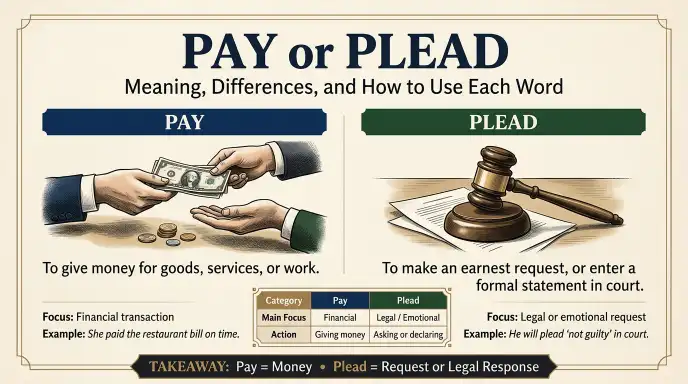
Pay or plead means choosing between paying a fine immediately or contesting it by pleading your case.
Whether it’s a parking ticket, a traffic citation, or a penalty notice, you usually have to make this decision within a strict deadline. The right choice depends on the evidence you have, the cost of the fine, and the consequences of each option.
Paying is fast and ends the matter, but it often counts as an admission of guilt and may affect your record or insurance. Pleading gives you a chance to have the fine reduced or dismissed, but it takes time and effort, and a failed appeal can sometimes increase what you owe.
In this guide, we explain how the pay or plead process works, what your options are, and when it makes sense to fight instead of paying. We also share practical tips to help you avoid costly mistakes and protect your finances.
Defination:
Pay or plead is a choice given to people who receive a fine, such as a parking ticket or traffic citation. You can pay the fine right away to settle the matter, or you can plead (appeal) to dispute it and ask for it to be reduced or dismissed.
Pay or Plead : Quick Answer
What Is the Difference Between Pay and Plead?
Pay means giving money that you owe. Plead means making a formal statement about a charge or claim in a legal case.
The two words are not interchangeable. They describe different actions, even when both appear in a discussion about a fine or court notice.
Here are some simple examples:
- Pay: I must pay the parking fine.
- Plead: The defendant will plead not guilty.
- Pay: She paid the fee before the deadline.
- Plead: He plans to plead guilty in court.
In some situations, a person who receives a traffic ticket may be allowed to pay the fine or contest the ticket through a legal process. However, the available options depend on the local law and the type of notice.
The phrase “pay or plead” is not a universal legal rule. It may be used informally to describe a choice between paying an amount and responding to a charge. Always read the full notice to understand what it requires.
Quick Comparison Table
| Word | Meaning | Example |
| Pay | Give money that is owed | I will pay the fine. |
| Plead | Make a formal statement in a legal case | She will plead not guilty. |
| Paid | Past form of pay | He paid the fee. |
| Pleaded | Past form of plead | The defendant pleaded guilty. |
The main point is simple: use pay when you mean giving money. Use plead when you mean making a formal statement in a legal matter.
The Origin of Pay or Plead:
Where Does the Word Pay Come From?
The word pay has roots in Old French and Latin. It entered English through the Anglo-French word paier, which was linked to the Latin word pacare. This Latin word meant to satisfy or bring peace.
Over time, the meaning of pay became closely linked to giving money to settle a debt or meet an obligation.
Today, people use pay in many situations. You can pay a bill, pay a worker, pay a fine, or pay for a service.
Examples include:
- I pay my phone bill every month.
- The driver paid the parking fine.
- We paid for our meal after dinner.
The word can also have wider meanings. For example, “You may pay the price for that mistake” means you may face the result of your actions. In this sentence, pay does not refer to money directly.
Where Does the Word Plead Come From?
The word plead comes from Anglo-French and Old French legal language, with roots linked to the Latin word placitum. It has long been used in connection with arguments, legal claims, and formal statements.
In modern English, plead is often used in court settings. A person may plead guilty, plead not guilty, or plead a legal defense.
Examples include:
- The defendant pleaded not guilty.
- She plans to plead her case before the judge.
- The lawyer asked the court to consider the facts.
The word can also be used outside a courtroom. For example, “I pleaded with my friend to stay” means I asked my friend strongly or urgently.
Why Are Pay and Plead Different?
Pay and plead have different meanings because they developed from different words and have been used for different purposes throughout the history of English.
There is no British-versus-American spelling difference between them. Both British and American English use pay and plead with the same spelling.
The past forms differ from the base forms:
- Pay → Paid
- Plead → Pleaded or pled
Both pleaded and pled are used as past forms of plead. Their use can vary by region and context. In formal writing, pleaded is a widely accepted choice.
British English vs American English Spelling:
Are Pay and Plead Spelled Differently in the UK and US?
No. The words pay and plead are spelled the same way in British English and American English.
The difference is mainly in their use and context, not their spelling. Both varieties use pay for giving money and plead for making a statement or strong appeal.
For example:
- British English: He paid the fine.
- American English: He paid the fine.
- British English: The defendant pleaded guilty.
- American English: The defendant pleaded guilty.
You may see pled guilty more often in some American legal reports, while pleaded guilty is also correct and widely understood. The best choice depends on the style guide, publication, or legal context.
Comparison Table: British English vs American English
| Point | British English | American English |
| Present form | Pay | Pay |
| Past form of pay | Paid | Paid |
| Present form | Plead | Plead |
| Past form of plead | Pleaded | Pleaded or pled |
| Legal phrase | Plead guilty | Plead guilty |
| Money-related phrase | Pay a fine | Pay a fine |
Do Legal Terms Change Between Countries?
Some legal terms and procedures differ between countries. For example, the way a person responds to a traffic ticket in England may differ from the process used in a US state.
However, these differences do not change the basic meanings of pay and plead. A payment is a financial action, while a plea is a formal response in a legal case.
If you are writing about a real legal matter, use the terms found in the relevant court’s official documents. This helps you avoid confusion and makes your writing more accurate.
Which Spelling Should You Use?
Advice for Writers in the United States
If you write for an American audience, use pay and plead as normal. Both spellings are correct in the United States.
For the past tense of plead, you may see both pleaded and pled. For example:
- The defendant pleaded guilty.
- The defendant pled guilty.
Both forms are used in American English. However, pleaded is a safe choice when you want a formal and widely accepted style.
When discussing a court case, do not assume that paying a fine always means admitting guilt. The legal effect of payment depends on the type of case and the applicable rules.
Advice for Writers in the UK and Commonwealth
British English also uses pay, paid, plead, and pleaded. These forms are understood across the UK and many Commonwealth countries.
If you are writing for a school, workplace, or professional publication, choose one style and use it consistently.
For example:
- She paid the fee on Monday.
- The defendant pleaded not guilty.
- He pleaded for more time to respond.
The first sentence describes a payment. The second describes a legal response. The third uses pleaded to mean asked earnestly.
Advice for Global English Writers
If your readers come from different countries, choose clear and simple wording.
Use pay the fine when you mean making a payment. Use enter a plea or plead guilty or not guilty when discussing a formal legal response.
If you are unsure if “pay or plead” is the correct phrase for a particular document, explain the two options separately instead of treating them as the same action.
Common Mistakes with Pay or Plead:
Mistake 1: Using Pay When You Mean Plead
Some writers use pay when they mean responding to a legal charge.
Incorrect: The defendant will pay not guilty.
Correct: The defendant will plead not guilty.
The phrase pay not guilty is incorrect because not guilty is a plea, not a payment.
Mistake 2: Using Plead When You Mean Pay
The opposite mistake happens when someone uses plead to describe paying money.
Incorrect: I will plead the parking fee tomorrow.
Correct: I will pay the parking fee tomorrow.
You pay a fee or fine. You plead in response to a legal charge or claim.
Mistake 3: Writing “Payed” Instead of “Paid”
The standard past tense of pay is paid.
Incorrect: I payed the bill yesterday.
Correct: I paid the bill yesterday.
The form payed appears in a few specialized nautical uses, but it is not the normal past tense for paying money.
Mistake 4: Thinking “Plead” Always Means a Court Statement
The word plead is common in legal settings, but it can also mean asking someone earnestly.
For example:
- The defendant pleaded not guilty.
- I pleaded with my brother to help me.
The first sentence is legal. The second describes a strong personal request.
Mistake 5: Assuming Paying a Fine Always Means the Same Thing
The legal effect of paying a fine can vary. In some systems, paying a ticket may count as accepting responsibility or resolving the matter. In other situations, different procedures may apply.
Do not assume that payment has the same effect in every country or case. Read the notice carefully and seek qualified legal advice if you do not understand your options.
Common Errors Table
| Incorrect or unclear wording | Better wording |
| I payed the fine. | I paid the fine. |
| He will pay not guilty. | He will plead not guilty. |
| She pleaded the bill. | She paid the bill. |
| The defendant paid guilty. | The defendant pleaded guilty. |
| I pleaded the price. | I paid the price. |
Pay or Plead in Everyday Examples:
Examples in Emails
Clear wording is important when writing emails about payments or legal matters. The reader should know if you are talking about money or a formal response.
Payment email:
“Hello, I have paid the fee today. Please confirm that you have received the payment.”
Legal inquiry email:
“Hello, I received a notice and would like to understand how I can respond to it. Could you please explain the next steps?”
The second example avoids assuming that paying or entering a plea is the only available option.
Examples in News Reports
News stories often use pay when discussing fines, fees, settlements, and compensation.
Examples:
- The company agreed to pay a fine.
- The driver paid the penalty after receiving the notice.
- The court ordered the business to pay compensation.
News reports use plead when describing a defendant’s response to a criminal charge.
Examples:
- The defendant pleaded not guilty in court.
- The accused pleaded guilty to the charge.
- The lawyer said the defendant would enter a plea at the next hearing.
These examples show why the words should not be confused. One refers to money, while the other refers to a legal response.
Examples on Social Media
On social media, people may use both words in short posts or comments.
Examples:
- “I need to pay my bills before Friday.”
- “He pleaded not guilty in court.”
- “I pleaded with my friend to come to the party.”
- “The company must pay the workers.”
In casual writing, the meaning may be clear from the rest of the sentence. However, legal matters should be described with care because a small wording mistake can change the meaning.
Examples in Formal Writing
Formal writing requires accurate wording.
| Purpose | Example |
| Business | The client paid the outstanding balance. |
| Education | Students must pay the required fee. |
| Legal reporting | The defendant pleaded not guilty. |
| Personal request | She pleaded for another chance. |
| Public notice | Payment must be made by the due date. |
Use pay for a financial duty and plead for a formal response or an earnest appeal.
Pay or Plead : Google Trends and Usage Data
Why Do People Search for Pay or Plead?
People may search for “pay or plead” after receiving a fine, traffic ticket, court notice, or other legal document. They may want to know if the phrase refers to a choice between paying money and responding to a charge.
Others may search for the phrase because they are learning English and want to understand the difference between the two words.
The search can have more than one intent:
- Meaning: What does “pay or plead” mean?
- Grammar: When should I use pay or plead?
- Legal information: What does a notice mean by payment or a plea?
- Writing: Which word belongs in a sentence?
Understanding the search intent helps explain why a clear answer should cover both word meanings and the possible legal context.
Is the Phrase More Popular in One Country?
There is no verified live Google Trends data in this article to show which country searches for the exact phrase “pay or plead” most often. Therefore, it would be misleading to claim that the phrase is more popular in the United States, United Kingdom, Canada, or another country without checking current data.
Search interest may depend on local legal procedures. For example, people may search for information about traffic tickets using the wording found on their local court websites.
You can compare interest in the phrase by visiting Google Trends and selecting the countries, time range, and search terms you want to examine.
How to Check Search Interest
Follow these simple steps:
- Open Google Trends.
- Enter “pay or plead” in the search box.
- Select a time range, such as the past 12 months.
- Choose a country or select worldwide results.
- Review related topics and queries, if available.
Keep in mind that Google Trends shows relative search interest, not the exact number of searches. A low or missing result may mean that the phrase has too little data to display.
For an article targeting this keyword, focus on answering the reader’s question clearly instead of making unsupported claims about popularity.
Pay or Plead: Comparison Table
Pay vs Plead vs Paid vs Pleaded
The following table compares the main forms and their uses.
| Word | Word type or form | Main meaning | Example |
| Pay | Base form | Give money | I need to pay the bill. |
| Paid | Past form of pay | Gave money | I paid the bill. |
| Plead | Base form | Make a formal response or ask earnestly | He will plead his case. |
| Pleaded | Past form of plead | Made a plea or strong request | She pleaded for help. |
| Pled | Alternative past form of plead | Made a plea | The defendant pled guilty. |
Which Word Fits Your Sentence?
Use the meaning of the sentence to choose the right word.
| If you want to say… | Use… | Example |
| Give money for a fine | Pay | I must pay the fine. |
| Give money in the past | Paid | She paid the fee. |
| Respond to a criminal charge | Plead | He will plead not guilty. |
| Responded to a charge in the past | Pleaded or pled | He pleaded guilty. |
| Ask someone strongly | Plead | I plead with you to listen. |
These examples show that pay and plead serve different purposes. The correct choice depends on the action you want to describe.
FAQs:
Q1. What Does It Mean to “Pay” vs. “Plead”?
Paying means accepting the fine and settling it right away, while pleading means disputing the fine and asking for it to be reduced or dismissed.
When you choose to pay, the case is closed immediately, but it usually counts as an admission of guilt. When you choose to plead, you formally challenge the ticket and present your side. Pleading takes more time, but it gives you a chance to avoid or reduce the penalty.
Q2. How Do I Pay a Traffic Ticket (Challan)?
You can pay a traffic ticket (challan) online, at a designated bank, or at the traffic police office before the due date.
Follow these simple steps:
- Find the ticket or challan number printed on your notice.
- Visit the official traffic police website or app and enter your challan number or vehicle number.
- Check the fine amount and pay using a debit card, credit card, or online banking.
- Save the payment receipt as proof.
Always use the official website only. Paying before the deadline helps you avoid late fees and extra penalties.
Q3. What Happens If I Ignore the Ticket and Do Not Pay or Plead?
If you ignore a ticket, the fine usually increases, and you may face legal action.
Missing the deadline can lead to late fees, a court summons, or even a warrant in serious cases. Your vehicle registration or driving license renewal may also be blocked until the fine is cleared. Ignoring a ticket never makes it go away, so always pay or plead before the due date.
Q4. When Does It Make Sense to Plead “Not Guilty”?
It makes sense to plead “Not Guilty” when you have clear evidence that the ticket was issued by mistake or unfairly.
Conclusion:
The difference between pay or plead is easy to understand once you know what each word means. Pay refers to giving money to meet an obligation, such as paying a bill, fee, or fine. Plead refers to making a formal statement in a legal case or asking strongly for something.
Both words are spelled the same way in British and American English. The past tense of pay is paid, while pleaded and pled can both be used as past forms of plead. Choosing the right form helps you write clear and correct sentences.
Remember that “pay or plead” does not always describe a simple choice. If you see these words on a court notice or legal document, read the full instructions carefully. The options and consequences can vary by location and case type. Do not assume that paying a fine always has the same legal effect.
For everyday English, keep the rule simple: pay money, plead a case, and check the context before choosing your words. With these examples and tips, you can use both words with greater confidence in emails, formal writing, and daily conversation.
You May Also Like!

I’m James Mitchell, a language and content writer focused on grammar, spelling, word usage, and everyday English. I enjoy making confusing words and common language questions simple and easy to understand.