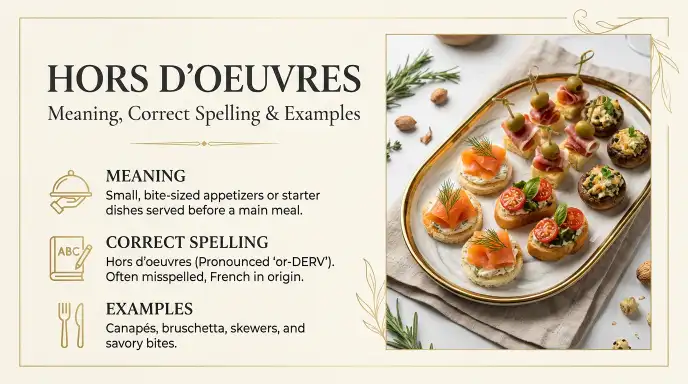
Hors d’oeuvres are small, bite-sized appetizers served before a meal, usually at parties, weddings, and gatherings.
Hors d’oeuvres set the tone for any event by giving guests something delicious to enjoy while they mingle. From classic cheese platters to modern finger foods, the right selection can make your party unforgettable.
In this guide, you will discover the best hors d’oeuvres ideas for every occasion, season, and budget. We cover hot, cold, vegetarian, and make-ahead options that anyone can prepare.
You will also learn how many hors d’oeuvres to serve per person and how to present them beautifully. These simple tips will help you look like a pro, even if you are hosting for the first time.
Defination:
Hors d’oeuvres are small, bite-sized appetizers served before a meal, usually at parties, weddings, and gatherings. They are typically eaten with fingers and can be served hot or cold, such as cheese bites, stuffed mushrooms, mini sandwiches, and canapés.
Or D’oeuvres : Quick Answer
What does or d’oeuvres mean?
The phrase “or d’oeuvres” is generally a misspelling of hors d’oeuvres. The correct term describes small portions of food served before a meal or at an event where guests may eat while standing and talking.
Common examples include:
- Mini sandwiches
- Cheese and crackers
- Stuffed mushrooms
- Small pieces of toast with toppings
- Olives and nuts
- Mini spring rolls
For example:
- Correct: We served hors d’oeuvres before dinner.
- Incorrect: We served or d’oeuvres before dinner.
The correct spelling is hors d’oeuvres, although hors-d’œuvre is also used in French-style spelling.
How do you pronounce hors d’oeuvres?
In English, hors d’oeuvres is often pronounced approximately as or-DERVZ. The exact sound may vary by speaker, but the initial “h” is silent.
The pronunciation is one reason people write “or d’oeuvres” when they hear the term spoken aloud.
Is it one word or more than one word?
In English, the usual spelling is two words: hors d’oeuvres. The French singular form is hors-d’œuvre, while the plural form is hors-d’œuvres. English writing often uses hors d’oeuvres for the plural.
The Origin of Or D’oeuvres:
Where does the term come from?
The correct phrase hors d’oeuvres comes from French. It is made from words that mean “outside” and “work” or “work of art,” depending on the context of œuvre.
In food terms, the phrase is commonly understood as “outside the main work,” referring to food served outside or before the main course. It describes a small dish that comes before the main part of a meal.
French dining customs helped spread the term to English-speaking countries. Over time, it became common in restaurant menus, cookbooks, catering services, and event invitations.
Why is the spelling so unusual?
There are several reasons why people find the spelling hard to remember.
First, the word comes from French, so it does not follow every spelling pattern that English learners expect. Second, the “h” is silent. Third, the word œuvre contains a French letter combination that is often written as oe in English text.
When people hear the phrase spoken aloud, they may write the sounds they hear. This can lead to spellings such as “or d’oeuvres,” “orderves,” or “hors deuvres.”
These spellings may appear in informal searches, but the standard English spelling is hors d’oeuvres.
How has the term changed over time?
The term has become part of everyday English, especially in food and hospitality. It is used for small dishes at weddings, business receptions, holiday parties, and other gatherings.
The foods themselves can come from many cultures. For example, an event may serve bruschetta, dumplings, samosas, cheese bites, or vegetable rolls as hors d’oeuvres.
The term is French, but the food does not have to be French.
British English vs American English Spelling:
Is the spelling different in British and American English?
No. British English and American English both use hors d’oeuvres as the standard spelling. There is no major regional spelling difference like the difference between colour and color.
The phrase is used in restaurants, hotels, catering menus, and formal invitations in both countries.
For example:
- British English: Light hors d’oeuvres will be served at the reception.
- American English: Light hors d’oeuvres will be served at the reception.
Both sentences are correct.
Comparison table: Correct and incorrect spellings
| Version | Is it correct? | Explanation |
| Hors d’oeuvres | Yes | Common English spelling |
| Hors-d’œuvres | Yes | French-style spelling with a hyphen and ligature |
| Hors d’œuvres | Yes | Uses the French ligature without the hyphen |
| Or d’oeuvres | No, in standard usage | Usually a misspelling |
| Ord’oeuvres | No | Incorrect word form |
| Hors deuvres | Not the preferred standard spelling | Often appears as a simplified misspelling |
Why do some websites use different forms?
Some websites use hors d’œuvres because it keeps the French ligature. Others use hors d’oeuvres because it is easier to type on a standard keyboard.
Both forms with the correct initial hors are widely understood. If you are writing in English, hors d’oeuvres is a practical and familiar choice.
For a formal menu or invitation, use one spelling consistently. Avoid changing between several forms in the same document.
Which Spelling Should You Use?
If your readers are in the United States
Use hors d’oeuvres. It is a familiar term in American restaurants, event planning, and catering.
Example:
“Please join us for cocktails and hors d’oeuvres at 6 p.m.”
This sentence is suitable for a formal invitation.
If your readers are in the United Kingdom
Use the same spelling. British English does not require a different form.
Example:
“Guests will be offered a selection of hors d’oeuvres before the meal.”
You may also see the term canapés on British menus. Canapés are a type of small, prepared food, often served at receptions.
If you write for a global audience
Use hors d’oeuvres the first time you mention the food. If you think some readers may not know the term, explain it in simple words.
For example:
“We will serve hors d’oeuvres, including small sandwiches, cheese, and vegetable bites, before dinner.”
This helps readers understand both the term and the food being offered.
When should you use a simpler phrase?
You do not always need to use a French term. Depending on the audience, words such as appetizers, small bites, or party snacks may be clearer.
For example:
- Formal: Hors d’oeuvres will be served at the reception.
- Simple: Small bites will be served at the reception.
- Casual: Snacks will be available before dinner.
Choose the phrase that best fits the event and the people who will read your message.
Common Mistakes with Or D’oeuvres:
Mistake 1: Writing or d’oeuvres
Incorrect: We prepared or d’oeuvres for the guests.
Correct: We prepared hors d’oeuvres for the guests.
The word or is not the correct beginning of this French food term. Remember that the standard spelling starts with hors, even though the “h” is silent.
Mistake 2: Writing ord’oeuvres as one word
Incorrect: The restaurant offers ord’oeuvres before dinner.
Correct: The restaurant offers hors d’oeuvres before dinner.
In standard English writing, the phrase is usually written as two words.
Mistake 3: Confusing pronunciation with spelling
People may hear something close to “or-derves” and spell it that way. However, English spelling does not always match the sound of a borrowed French word.
The best way to avoid this mistake is to learn the written form and remember that the initial “h” is silent.
Mistake 4: Using hors d’oeuvres when you mean the main meal
Hors d’oeuvres are generally small foods served before a meal or at a reception. They are not normally the main course.
Incorrect: Our main course was a plate of hors d’oeuvres.
This sentence may be possible if the event serves only small dishes, but it can be unclear.
Clearer: We served a selection of small bites instead of a full meal.
Mistake 5: Confusing hors d’oeuvres with appetizers
The terms overlap, but their use can vary by event and dining style. Appetizers often refers to the first course of a meal. Hors d’oeuvres often refers to small foods served before a meal or passed around at a reception.
They are similar, but they are not always exact substitutes.
Mistake 6: Forgetting the apostrophe
The spelling hors d’oeuvres uses an apostrophe in the common English form. The French form hors-d’œuvres uses the ligature œ.
Both are recognizable forms, but it is best to choose a standard version and use it consistently.
Or D’oeuvres in Everyday Examples:
In emails
The phrase is often used in invitations and event planning emails.
Examples:
- We will provide hors d’oeuvres before the presentation.
- Please let us know if you have any dietary needs.
- Light hors d’oeuvres and soft drinks will be available.
These sentences sound suitable for workplace events and formal gatherings.
In news and event reports
News stories may mention hors d’oeuvres when describing receptions, award ceremonies, or public events.
Examples:
- Guests enjoyed hors d’oeuvres before the award ceremony.
- The reception featured local dishes and traditional hors d’oeuvres.
- Organizers served light hors d’oeuvres after the opening speech.
On social media
People may use the term in posts about parties, weddings, and food events.
Examples:
- Getting ready for a night of good food and hors d’oeuvres!
- Our wedding reception will feature fresh hors d’oeuvres.
- Simple hors d’oeuvres can make a party feel special.
For casual captions, party bites or small bites may sound more natural.
In formal writing
In professional writing, the term can describe the food offered at a reception or before a meal.
Example:
“The hotel will provide a range of hors d’oeuvres during the welcome reception.”
This is clear and appropriate for an event proposal, hotel brochure, or business invitation.
Comparison table: Similar food terms
| Term | Meaning | Example |
| Hors d’oeuvres | Small foods served before a meal or at a reception | Cheese bites were served as hors d’oeuvres. |
| Appetizers | Foods served before the main course | We ordered two appetizers. |
| Canapés | Small pieces of food, often served on bread or crackers | The waiter offered salmon canapés. |
| Snacks | Small amounts of food eaten between meals or casually | We bought snacks for the party. |
| Finger foods | Foods easy to eat by hand | The guests enjoyed finger foods. |
These terms can overlap, but the best choice depends on the type of food and the setting.
Or D’oeuvres : Google Trends and Usage Data:
Why do people search for this phrase?
People may search for “or d’oeuvres” because they heard the phrase in conversation, saw it on a menu, or need to write it in an invitation. Since the correct spelling is not easy to guess from the pronunciation, spelling questions are common.
Searchers may also want to know the meaning, pronunciation, or difference between hors d’oeuvres and appetizers.
Which countries may search for it?
The term is relevant in English-speaking regions such as the United States, the United Kingdom, Canada, and Australia. It may also be useful to English learners in countries where restaurants, hotels, and event planners use French food terms.
However, these are possible audiences, not verified search rankings. A live Google Trends comparison is needed to determine which country has the highest relative interest in this exact phrase.
How can Google Trends help?
Google Trends lets you compare search interest by region and over time. Its scale runs from 0 to 100, where 100 represents the highest relative interest in the selected comparison.
You can compare terms such as:
- Or d’oeuvres
- Hors d’oeuvres
- Hors d’oeuvres meaning
- How to spell hors d’oeuvres
- Hors d’oeuvres pronunciation
The correct spelling may be more useful for readers who want to learn the term, while the misspelled version can help identify people who need spelling guidance.
How should you use this information in an SEO article?
Focus on the question the reader wants answered. Explain that “or d’oeuvres” is generally a misspelling, provide the correct form, and include the meaning and examples.
Use related phrases naturally. Do not repeat the misspelling in every paragraph or claim that your article will rank first on Google. No keyword or writing method can guarantee a top position.
A clear answer, correct information, useful examples, and easy navigation give readers a better experience.
FAQs:
Q1: What is the meaning of d’oeuvres?
“D’oeuvres” is part of the French phrase hors d’oeuvres, which literally means “outside the main work.” It refers to small, bite-sized appetizers served before a meal, usually at parties, weddings, and gatherings.
Q2: Is it horderves or hors d’oeuvres?
The correct spelling is hors d’oeuvres. “Horderves” is a common misspelling based on how the word sounds. It is pronounced or-DERVZ, and the spelling is the same for both singular and plural.
Q3: How to use hors d’oeuvres in a sentence?
Here are some simple examples:
- “The waiters served hot hors d’oeuvres as guests arrived.”
- “We ordered cheese bites and mini sandwiches as hors d’oeuvres for the party.”
- “She prepared a variety of vegetarian hors d’oeuvres for the wedding reception.”
Q4: What are our d’oeuvres?
“Our d’oeuvres” is usually a mistaken search for “hors d’oeuvres”, as the two sound alike. Hors d’oeuvres are small appetizers such as stuffed mushrooms, bruschetta, mini quiches, and cheese platters. If you saw “our d’oeuvres” on a menu, it simply means “our appetizers.”
Q5: What are 7 types of appetizers?
The 7 most popular types of appetizers are:
- Canapés: small bread or cracker bases with toppings
- Finger foods: chicken wings, spring rolls, and mini samosas
- Dips and spreads: hummus, guacamole, and spinach dip
- Stuffed bites: stuffed mushrooms and jalapeño poppers
- Skewers: chicken tikka sticks and caprese skewers
- Soups and shooters: small servings in cups or shot glasses
- Cheese and charcuterie platters: cheeses, cured meats, fruits, and nuts
Q6: How to make d’oeuvres?
Follow these easy steps to make hors d’oeuvres at home:
- Choose your type: Pick hot, cold, or make-ahead options based on your event.
- Keep it bite-sized: Each piece should be eaten in one or two bites.
- Prepare the base: Use crackers, mini tart shells, bread slices, or skewers.
- Add toppings or fillings: Try cream cheese, vegetables, chicken, or herbs.
- Serve nicely: Arrange on a platter and garnish with fresh herbs.
Conclusion:
The phrase “or d’oeuvres” is usually a misspelling of “hors d’oeuvres.” The correct term refers to small portions of food served before a meal or at a gathering. These foods can include mini sandwiches, cheese and crackers, olives, canapés, and other bite-sized dishes.
The spelling can be confusing because the word comes from French, the initial “h” is silent, and the written form does not match the way many people expect it to sound. However, once you learn the correct spelling, it becomes easier to recognize and use.
Remember that hors d’oeuvres is the standard English form in both British and American English. You can use it in restaurant menus, formal invitations, catering plans, and professional emails. If your audience prefers simple language, terms such as small bites, appetizers, or party snacks may be easier to understand.
When writing about food, focus on clarity and correct spelling. If you are unsure, check the phrase before publishing your menu or invitation. A small spelling correction can make your writing look more polished and professional.
Most importantly, remember the key difference: write “hors d’oeuvres,” not “or d’oeuvres,” when you mean small dishes served before a meal or at a reception.
Continue Reading!

I’m James Mitchell, a language and content writer focused on grammar, spelling, word usage, and everyday English. I enjoy making confusing words and common language questions simple and easy to understand.